





















Key takeaway: GanttPRO ranks as my best Gantt chart software for tracking how schedule changes affect planned and actual project costs. Zoho Projects is better for surfacing issues linked to scheduled tasks, while ClickUp is better at automatically adjusting downstream deadlines when a task is delayed.
As someone who relies on Gantt chart tools for planning, I expect more than a visual timeline. I want a tool that helps me understand the impact of schedule changes, identify dependency risks, and confirm whether my team has the capacity to deliver as planned. After testing Gantt software across different project environments, I compared how each one handles schedule changes.
| Best for | Monthly starting fee | |
| GanttPRO | Best for schedule cost tracking | $8/user |
| Zoho Projects | Best for project issue tracking | $4/user |
| ClickUp | Best for shifting dependent deadlines | $7/user |
| monday.com | Best for status-triggered schedule updates | $9/user |
| Wrike | Best for booking future capacity | $10/user |
| Smartsheet | Best for reporting schedule changes | $9/user |
| TeamGantt | Best for sharing client timelines | $24/mo |
| Asana | Best for reallocating cross-project work | $10.99/user |
| Microsoft Planner | Best for critical path analysis | $10/user |
- 1. GanttPRO – Best for schedule cost tracking
- 2. Zoho Projects – Best for project issue tracking
- 3. ClickUp – Best for shifting dependent deadlines
- 4. monday work management– Best for status-triggered schedule updates
- 5. Wrike – Best for booking future capacity
- 6. Smartsheet – Best for reporting schedule changes
- 7. TeamGantt– Best for sharing client timelines
- 8. Asana– Best for reallocating cross-project work
- 9. Microsoft Planner – Best for critical path analysis
- How to choose the best Gantt chart software
- FAQs
1. GanttPRO – Best for schedule cost tracking
- My rating: 4.85 out of 5
- Free trial available
- Starts at $8/user/month
Why I chose GanttPRO
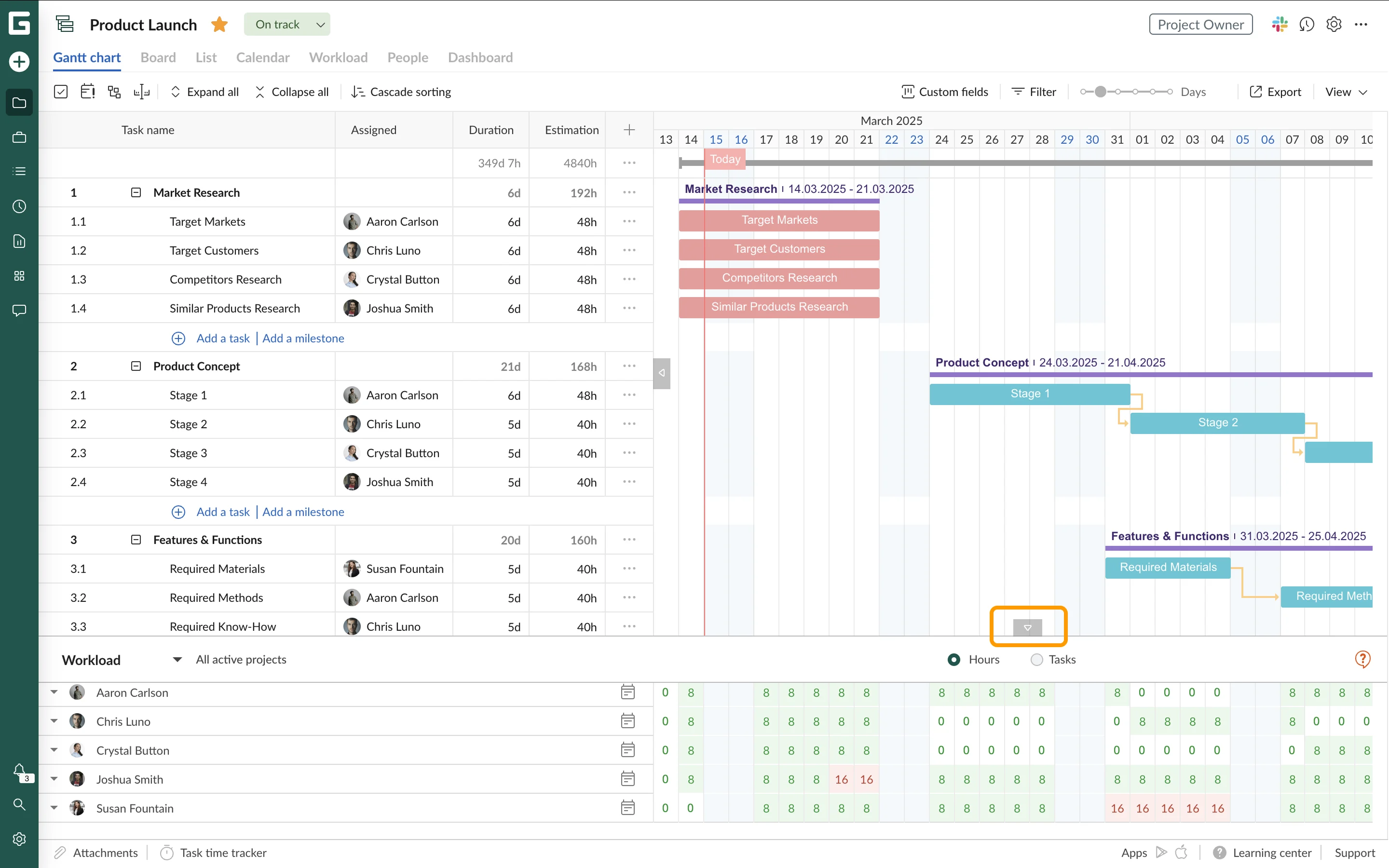
When schedule delays change labor or material costs, GanttPRO automatically updates the budget alongside the project timeline. This is especially useful for construction projects or client work because you can immediately see how a delayed task affects projected spending instead of recalculating costs in a separate spreadsheet.
I can assign hourly rates to team members, set per-item costs for materials, and add fixed expenses such as hosting fees. GanttPRO then calculates the planned cost for each task based on the assigned work or materials. As the team logs hours and updates task progress, the software compares actual spending with both the current budget and the original baseline, making it easy to identify which task exceeded the budget.
The catch: Budget reports are available only on the Business and Enterprise plans, and report creation is limited to account owners, admins, or Enterprise users with the appropriate permissions. If your priority is tracking how project costs are distributed across calendar months, TeamGantt is the better choice because its cost view automatically updates monthly spending as the schedule changes.
Pros
Cons
Key features
- Budget analysis report: Compare planned budgets, current budgets, and actual costs across projects
- Time log: Record task hours and use past results when estimating similar work
- Virtual resources: Reserve work for roles, contractors, or equipment before selecting specific resources
- Workload: Compare assignments across projects to prevent people from exceeding their available hours
Pricing
- Free trial for paid plans: 14 days
- Core: $8/user/mo. – Includes Gantt charts, project calendars, automatic scheduling, and virtual resources.
- Advanced: $12/user/mo. – Includes overdue task controls, custom fields and filters, calendar exceptions, and reusable project templates.
- Business: $19/user/mo. – Includes workload management, portfolio reporting, budget planning, and time tracking.
- Enterprise: $25/user/mo. – Includes SAML SSO, custom roles and permissions, onboarding assistance, and priority support.
All prices above are quoted for 10 members, billed annually.
AI pricing note: The AI Gantt Chart Maker is included with every plan.
2. Zoho Projects – Best for project issue tracking
- My rating: 4.74 out of 5
- Free plan available
- Starts at $4/user/month
Why I chose Zoho Projects
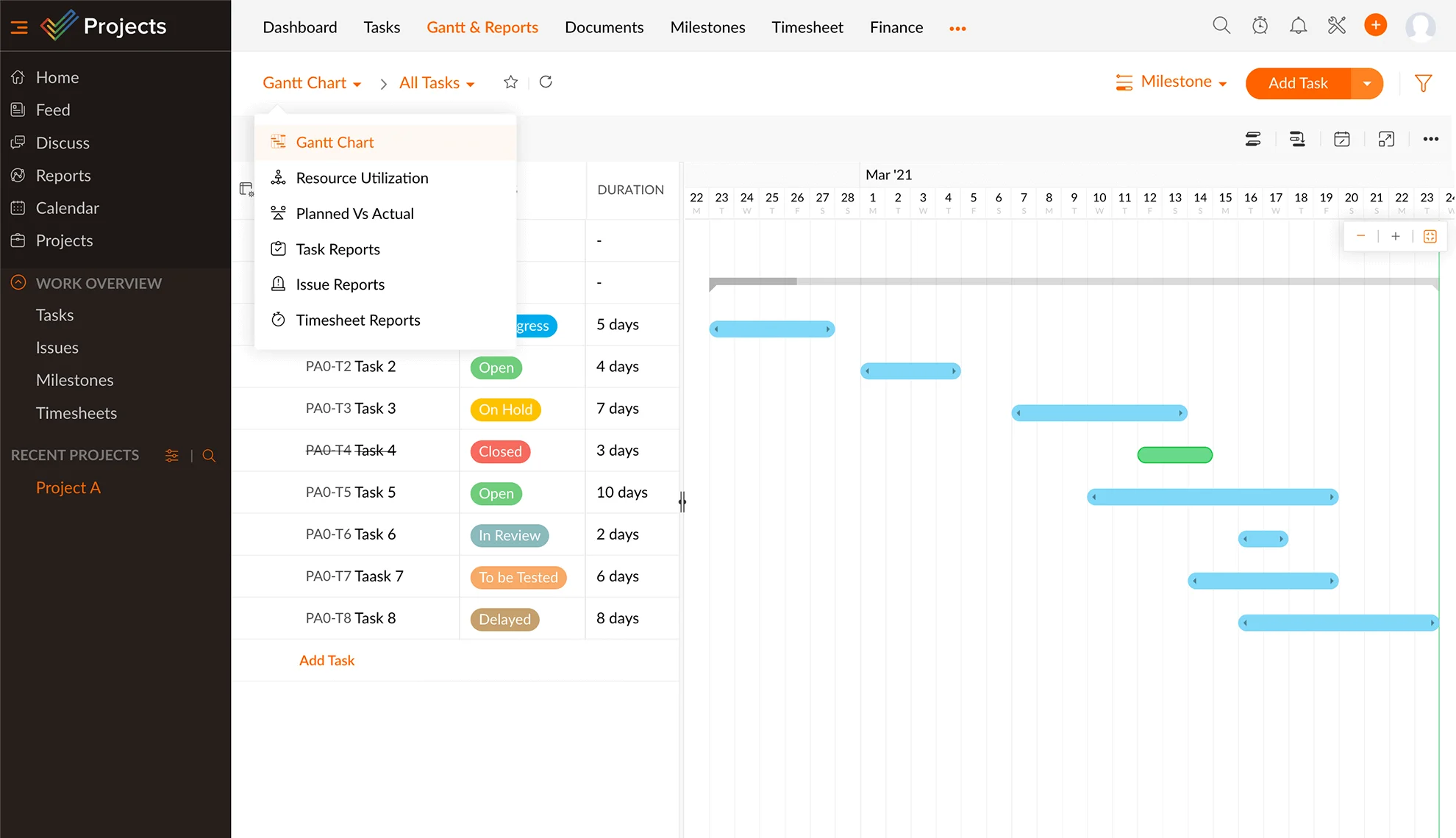
For release plans that include software defects or client-reported issues, I use Zoho Projects to track those problems separately from routine task updates. Each issue can have its own priority, owner, deadline, and escalation process before I link it to the affected task on the project schedule.
During a software rollout, for example, I can record a defect in the issue tracker and connect it to the related Gantt task. I can then create a rule that updates the issue or alerts the responsible team when certain conditions are met.
On the Enterprise and Ultimate plans, service-level rules can set resolution deadlines and escalate overdue issues through up to four levels. This helps me identify which unresolved defects could delay the release without creating a separate spreadsheet.
The limitation: Issues and tasks remain separate records in Zoho Projects. I still need to link an issue to a scheduled task before its effect appears in the project plan. ClickUp is a better option when blockers should remain part of the task schedule and a delayed blocking task needs to move dependent dates.
Pros
Cons
Key features
- Blueprint: Require tasks to follow predefined statuses, approvals, and assigned owners
- Project budget: Compare planned costs with actual costs before approving more spending
- Resource utilization chart: Reassign work when scheduled hours exceed a team member’s capacity
- Automated issue tracking: Apply SLAs, escalations, and business rules to unresolved project issues
Pricing
- Free plan: Includes up to five users, three projects, subtasks, and 5GB of storage.
- Free trial for paid plans: 15 days
- Premium: $4/user/mo. – Includes unlimited projects, project budgets and earned value management, time logs and timesheets, and Zia AI capabilities.
- Enterprise: $9/user/mo. – Includes portfolio dashboards, critical path and baselines, SSO, and 50,000 monthly workflow executions.
- Ultimate: $14/user/mo. – Includes 100 resources, unlimited custom dashboards, cross-project timesheets, and 500,000 monthly workflow executions.
All quotes above are billed annually.
AI pricing note: Zia AI is included with paid plans
Read our full Zoho Projects review.
3. ClickUp – Best for shifting dependent deadlines
- My rating: 4.63 out of 5
- Free plan available
- Starts at $7/user/month
Why I chose ClickUp
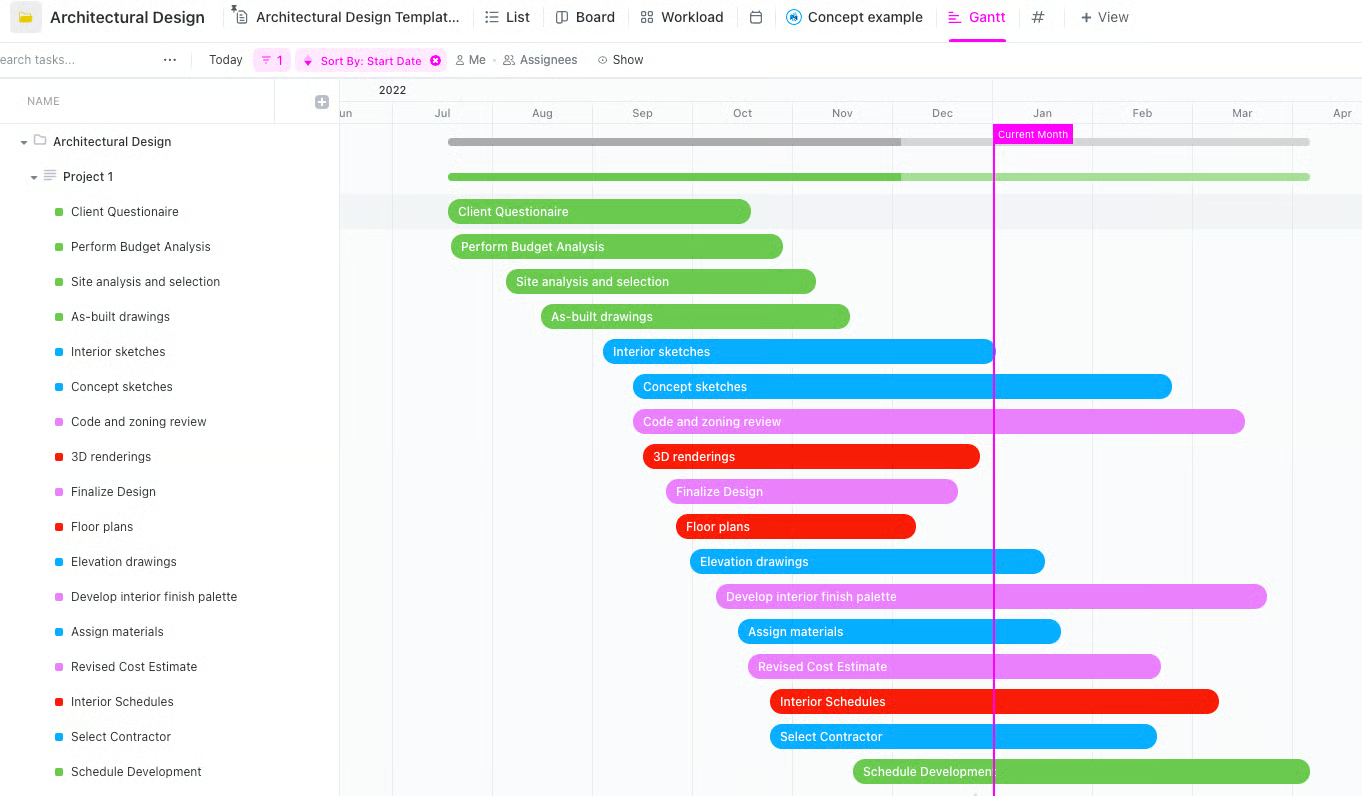
For projects with long chains of dependent work, I use ClickUp to adjust downstream dates when a blocking task is delayed. Instead of updating every affected task by hand, the schedule stays aligned as dependencies shift.
Once I link dependent tasks, changing the due date of a blocking task moves every connected task by the same amount. If I also set task durations and enable non-working days, ClickUp calculates new start and finish dates, skipping weekends or company holidays. Automatic dependency rescheduling is available on every plan, although task durations require the Unlimited plan or higher, making it much easier to keep large schedules up to date after delays.
The trade-off: One limitation is that automatic rescheduling applies only to tasks visible in the Gantt chart. If filters hide part of the project, those tasks will not move until the filters are cleared. monday Work Management is a better choice when you want dependency rules to apply across an entire board, with the option to decide whether downstream tasks always shift or only move when dates would otherwise overlap.
Pros
Cons
Key features
- Forms: Turn submitted requests into assigned tasks with complete project information
- Goals: Link team objectives to tasks and calculate progress from completed work
- Dashboards: Combine project, workload, time, and budget data into live reports
- ClickUp Brain: Generate project plans, tasks, and status updates from workspace data
Pricing
- Free plan: Includes unlimited tasks, unlimited plan members, collaborative docs, and sprint management.
- Unlimited: $7/user/mo. – Includes unlimited Gantt charts, unlimited storage, native time tracking, and portfolio management.
- Business: $12/user/mo. – Includes advanced dashboards, 5,000 monthly automations, sprint reporting, and portfolio workload management.
- Enterprise: Custom pricing – Includes enterprise permissions, SAML SSO and SCIM provisioning, audit logs, and 250,000 monthly automations.
All quotes above are billed annually.
AI pricing note: Brain AI costs $9/user/mo. and includes 1,500 monthly AI Super Credits, while Everything AI costs $28/user/mo. and includes 5,000 credits. Additional credits cost $10 per 10,000.
Read our full ClickUp review.
4. monday work management– Best for status-triggered schedule updates
- My rating: 4.62 out of 5
- Free plan available
- Starts at $9/user/month
Why I chose monday work management
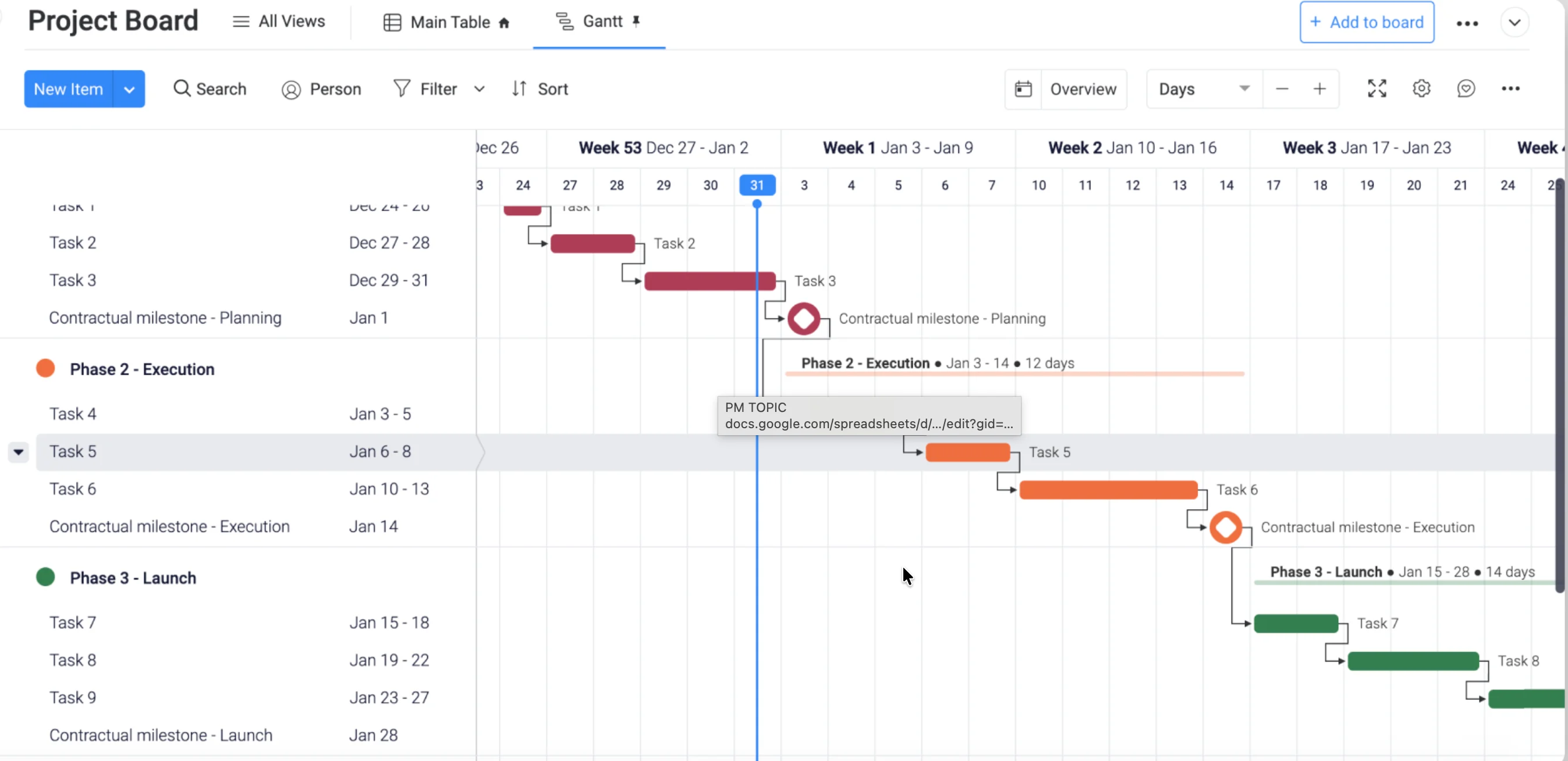
When project schedules depend on status updates, monday.com lets me adjust deadlines automatically. This works well for marketing campaigns, content production, or other workflows where team members update task statuses as work progresses.
For example, I can create an automation that pushes a task’s due date by a set number of business days when its status changes to “Stuck” or “Approved.” The rule can also notify the next person responsible for the work.
Since the Gantt chart uses the same project data, the updated dates appear immediately. Depending on the dependency settings, later tasks can either shift by the same amount or move only when a scheduling conflict would occur.
The drawback: Automation usage depends on your plan. While the Standard plan includes the Gantt view, it allows only 250 credits per month, which can be used up quickly by active teams. The Pro plan increases that limit to 25,000 actions. If your priority is dependency-based schedule updates, ClickUp is the better option because automatic dependency rescheduling is available across its plans without a monthly automation allowance.
Pros
Cons
Key features
- WorkForms: Collect project requests into boards for review and assignment
- AI workflow builder: Create multi-step workflows from written instructions and business conditions
- Resource planner: Allocate people across projects and compare planned work with available capacity
- Managed templates: Publish approved workflow changes to every connected board or workspace
Pricing
- Free plan: Includes up to two seats, three boards, three workdocs, and mobile apps.
- Free trial for paid plans: 14 days for the Pro plan
- Basic: $9/user/mo. – Includes unlimited items, unlimited free viewers, basic project boards, and 1,000 monthly AI credits.
- Standard: $12/user/mo. – Includes Timeline and Gantt views, guest access, calendar view, and 250 monthly automation actions.
- Pro: $19/user/mo. – Includes advanced dependencies, time tracking, private boards and docs, and 25,000 monthly automation actions.
- Enterprise: Custom pricing – Includes enterprise security and governance, portfolio management, resource planning, and up to 250,000 monthly automation actions.
All quotes above are billed annually.
AI pricing note: Basic includes 1,000 monthly credits, Standard includes 2,000 credits, Pro includes 3,000 credits, and Enterprise receives a custom allocation.
Read our full monday.com review.
5. Wrike – Best for booking future capacity
- My rating: 4.58 out of 5
- Free plan available
- Starts at $10/user/month
Why I chose Wrike
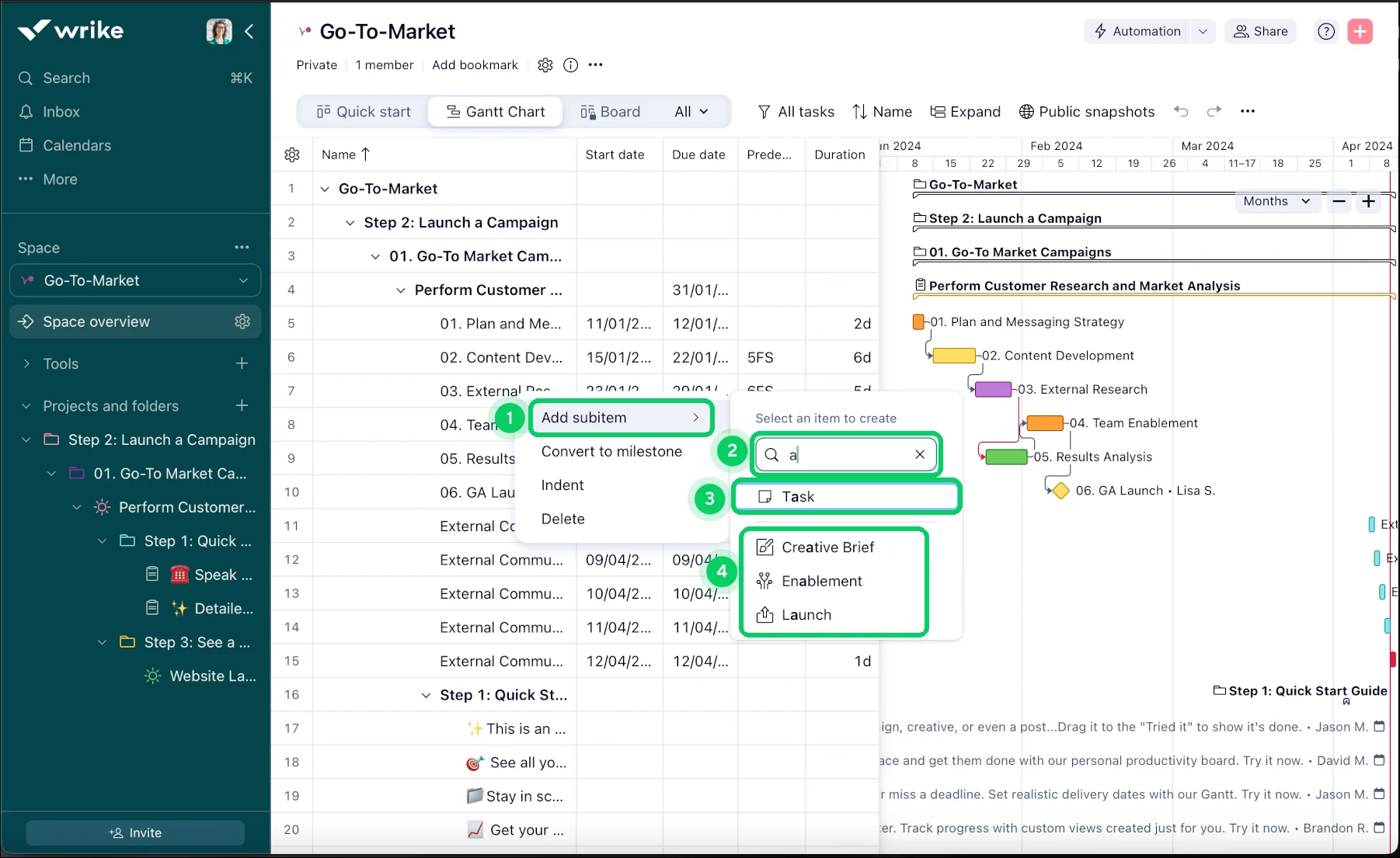
Before integrating a task list into the project schedule, I use Wrike to reserve future capacity for specific employees or job roles. This benefits professional services teams and PMOs that need to commit people to upcoming work before scheduling begins.
At the project level, I can reserve a set number of hours for a named specialist or an open role across a chosen date range. Once tasks are created, Wrike compares the reserved hours with the effort assigned to those tasks. The booking turns red when daily demand exceeds the reserved capacity. Workload charts also include assignments from other projects, so I can check whether a future commitment would overload someone.
The catch: Staff bookings are available only on the Pinnacle and Apex plans, although workload charts start on the Business plan. Asana is a better option when the priority is rebalancing tasks that are already scheduled across projects.
Pros
Cons
Key features
- Custom item types: Create controlled work records for requests, campaigns, projects, or other processes
- Bookings: Reserve employee or role capacity for projects before individual tasks exist
- AI risk prediction: Flag projects likely to miss deadlines and show contributing issues
- Proofing and approvals: Review files, compare versions, record decisions, and identify delayed approvals
Pricing
- Free plan: Includes task management, project scheduling, board views, and table views.
- Free trial for paid plans: 14 days
- Team: $10/user/mo. – Includes interactive Gantt charts, shareable dashboards, AI Essentials, and access for two to 15 users.
- Business: $25/user/mo. – Includes customizable workflows, reusable templates, standard integrations, and introductory AI Elite actions.
- Pinnacle: Custom pricing – Includes advanced resource planning, project budgeting, business intelligence reporting, and increased AI Elite actions.
- Apex: Custom pricing – Includes expanded AI automation, unlimited whiteboards, Wrike Integrate, and Wrike Sync.
AI pricing note: AI Essentials is included with Team, while higher plans receive more AI Elite actions. Additional AI Elite action packs have custom pricing.
Read our full Wrike review.
6. Smartsheet – Best for reporting schedule changes
- My rating: 4.56 out of 5
- Free trial available
- Starts at $9/user/month
Why I chose Smartsheet
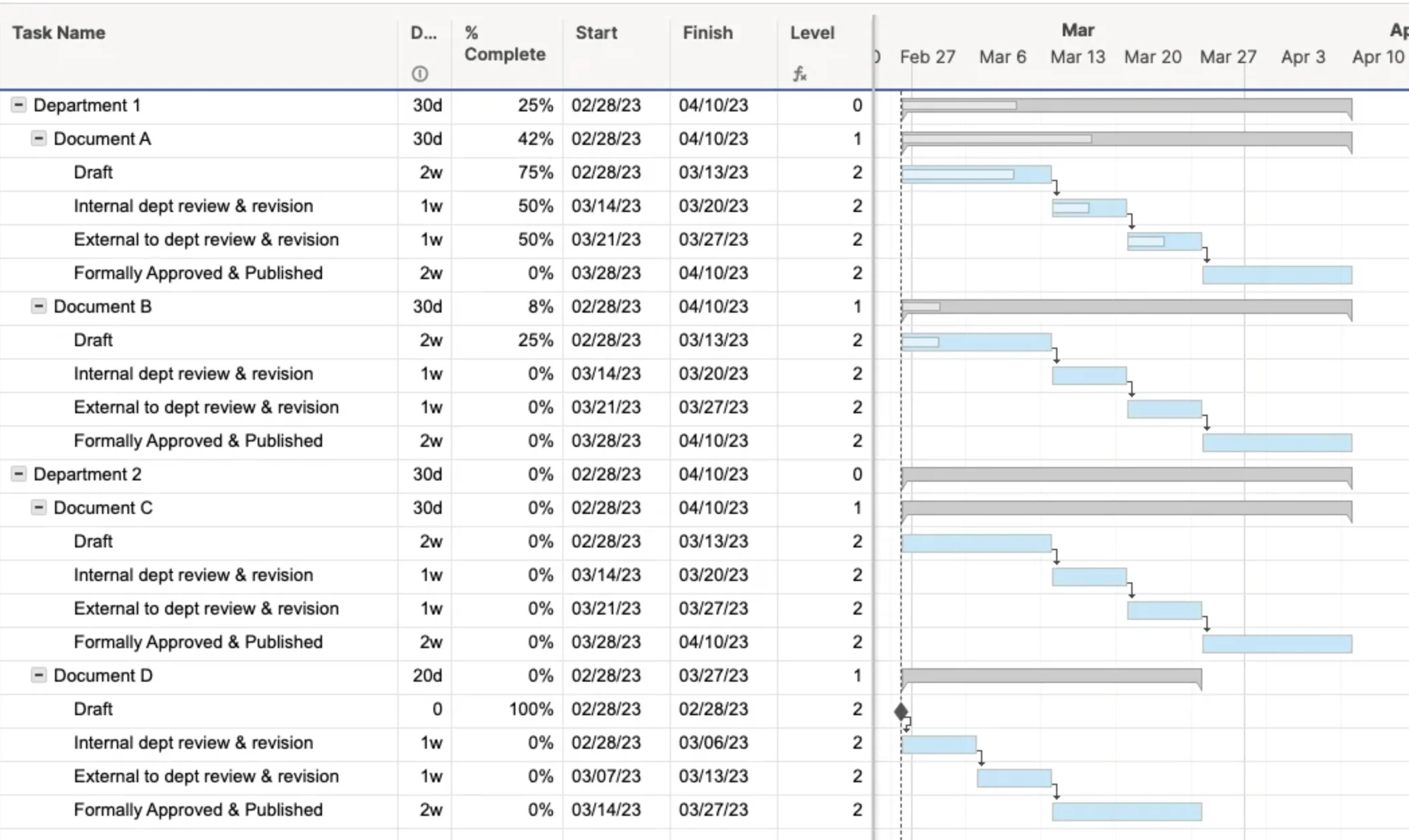
When leadership wants to see which projects are not following the planned schedule, Smartsheet lets me track schedule variance across the portfolio. Standardizing project sheets means every project measures delays the same way, making cross-project reporting much easier.
After I save the original schedule as a baseline, Smartsheet stores the baseline start and finish dates alongside the current schedule and automatically calculates the variance whenever dates change. I can then pull delayed tasks from multiple projects into a single report or combine project metrics into a dashboard for executives. This eliminates the need to consolidate schedule updates before a steering meeting, while stakeholders can review the latest figures without changing the underlying project plans.
The tradeoff: Baseline bars appear only in individual Gantt charts. They are not shown in reports, dashboard report widgets, or printed Gantt views, so portfolio reporting relies on baseline dates and variance values instead of visual comparisons. If the priority is sharing a simple, client-friendly project timeline rather than building portfolio reports across multiple projects, TeamGantt is the better choice.
Pros
Cons
Key features
- Control Center: Create projects from approved blueprints and apply portfolio-wide changes from one location
- Dynamic View: Share selected fields with vendors without exposing the underlying sheet
- Data Shuttle: Import and export recurring spreadsheet data between Smartsheet and business systems
- Resource management: Compare staffing demand, availability, time, and project budgets before assigning people
Pricing
- Free trial for paid plans: 30 days
- Pro: $9/member/mo. – Includes Gantt views, unlimited sheets and reports, 250 monthly automations, and conversational AI features.
- Business: $19/member/mo. – Includes Timeline view, workload tracking, unlimited automations, and administrative controls.
- Enterprise: Custom pricing – Includes portfolio management, scenario planning, SAML-based SSO, and enterprise account controls.
- Advanced Work Management: Custom pricing – Includes Control Center, Dynamic View, data management tools, and premium support.
All quotes above are billed annually.
AI pricing note: AI features are included with paid plans
Read our full Smartsheet review.
7. TeamGantt– Best for sharing client timelines
- My rating: 4.56 out of 5
- Free plan available
- Starts at $24/user/month
Why I chose TeamGantt
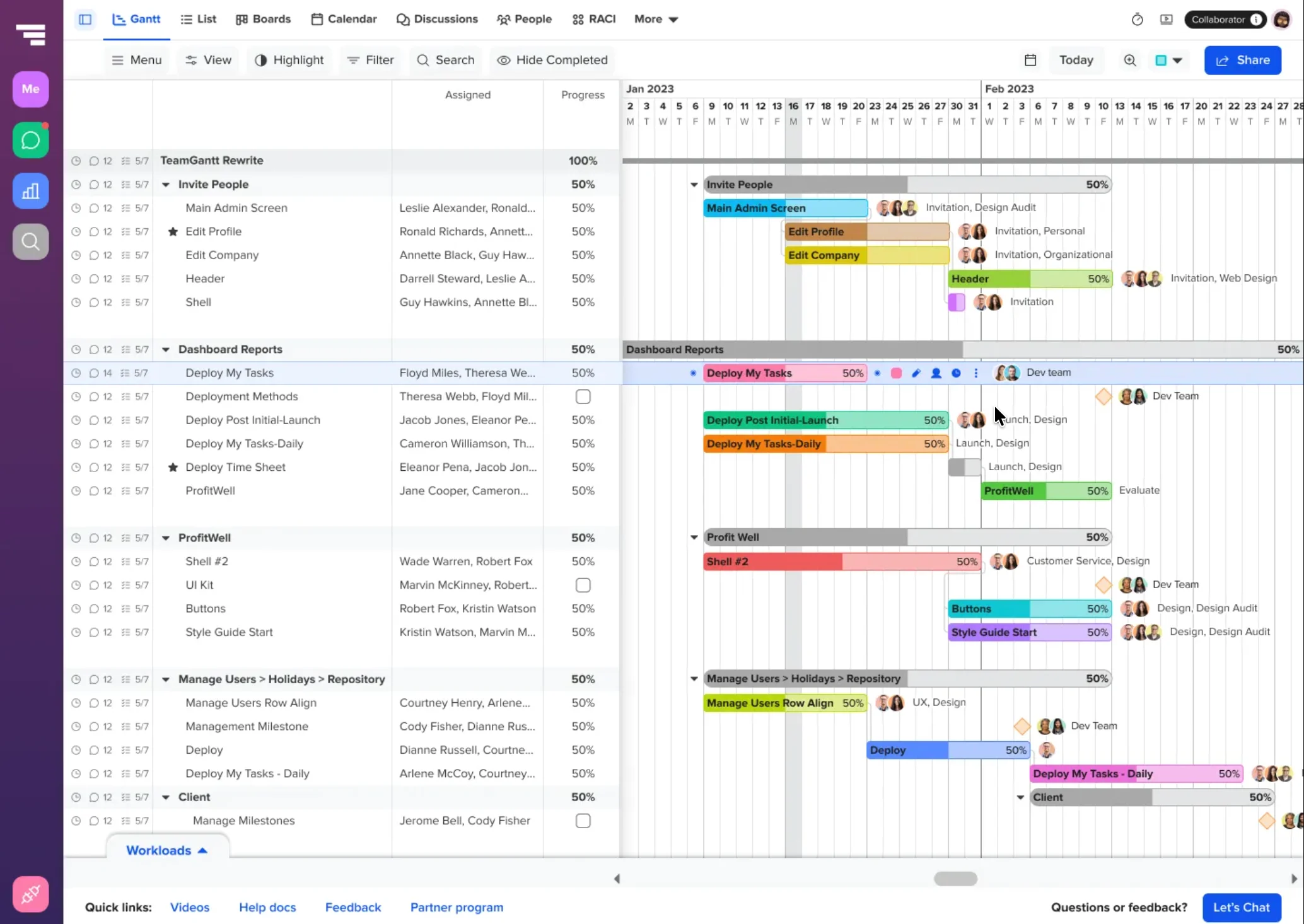
For agency or consulting projects, you can use TeamGantt to share a live schedule with clients without giving them access to the account. They can see the latest timeline as dates change, so the project team does not need to send a new PDF for every update.
I can filter the Gantt chart to show only the tasks a client needs to see, choose which details appear, and send a view-only link that works without a TeamGantt login. A single link can also include several projects, which is useful when an account lead needs to present related work in one place. When a client needs to comment on a task, I can invite them as a collaborator with view and comment access.
The drawback: View-only links require a paid plan or premium trial. On the free plan, the only sharing option is a static PDF. ClickUp is the better choice when free public sharing is essential because public links are available on every plan, although its Free plan limits Gantt use to 60 actions.
Pros
Cons
Key features
- Project health report: Compare progress across active projects and identify delayed work
- RACI chart: Record who completes, approves, advises, and receives updates for each task
- Time tracking report: Review recorded hours by person or project for billing
- Workloads: Compare assignments across projects before giving employees extra work
Pricing
- Free plan: Includes one project with up to 40 tasks.
- Free trial for paid plans: 14 days.
- Basic: $24/mo. Includes two projects (extra projects at 12/mo. each), Gantt planning, project collaboration, calendar views, and file management.
- Business: $120/mo. Includes five projects (extra projects at $24/mo. each), workload management, portfolio oversight, project health reporting, and time tracking.
- Builder Edition: $199/mo. ($1,908/year on annual billing) Includes 10 projects, construction scheduling, training sessions, and unlimited users.
- Enterprise: Custom pricing. Includes unlimited projects, reporting, forecasting, account support, and access to all platform functions.
8. Asana– Best for reallocating cross-project work
- My rating: 4.32 out of 5
- Free plan available
- Starts at $10.99/user/month
Why I chose Asana
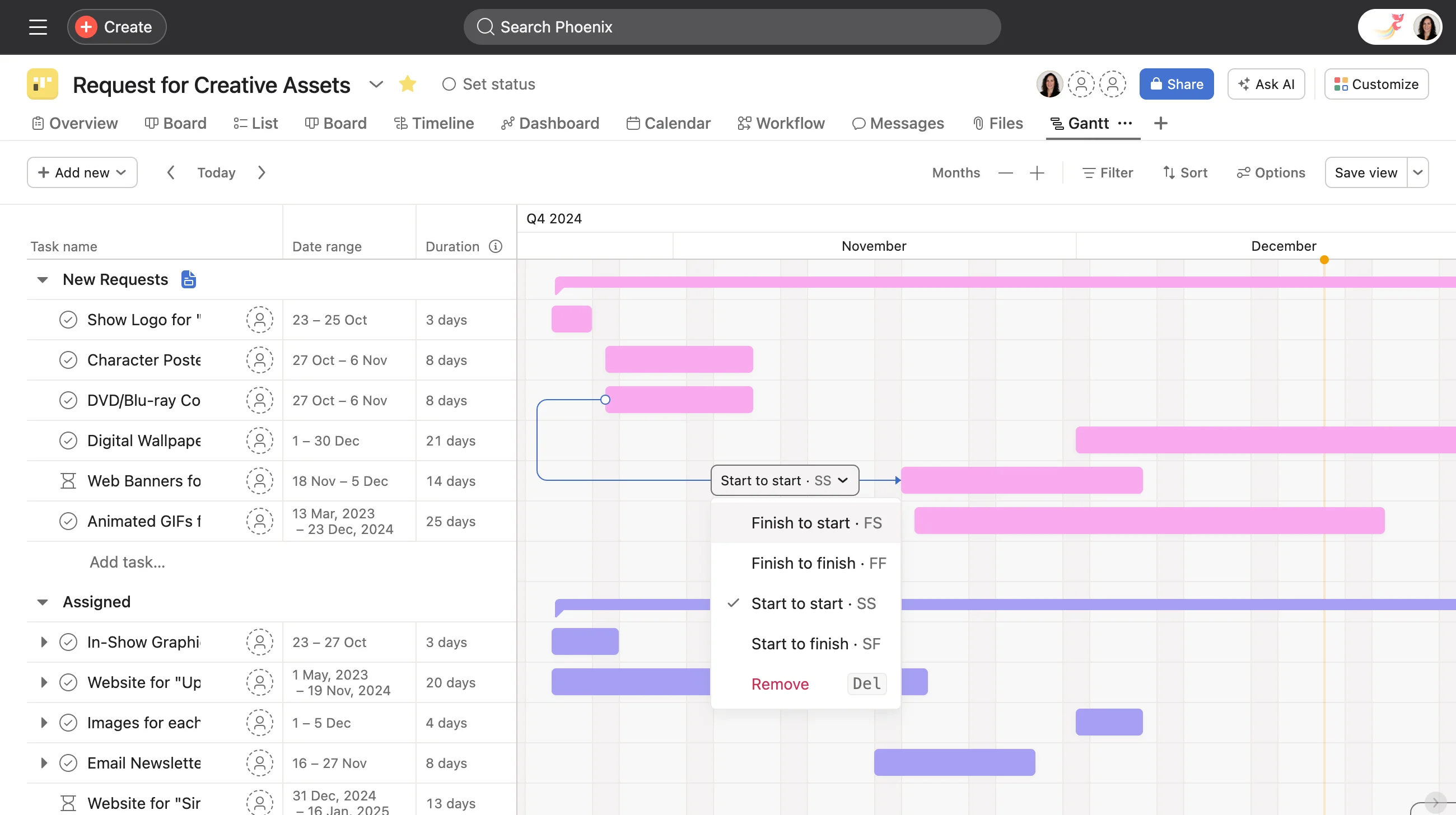
When the same team member is assigned to multiple projects, I use Asana to review their workload before reassigning work. This helps department managers make staffing decisions based on a person’s total commitments instead of the tasks visible in a single project.
The portfolio workload view combines assignments from related projects into one capacity timeline and measures demand by either task count or estimated effort. From there, I can review someone’s schedule and drag a task to a different owner or due date. Any changes made will automatically update the project plans, eliminating the need to collect workload data from every project manager before redistributing work.
The limitation: Workload calculations depend on accurate task assignments, dates, and effort estimates. Portfolio workload is also available only on the Advanced plan and above. Wrike is a better choice when staffing decisions happen before creating a detailed project plan because it can reserve future hours for specific people or job roles.
Pros
Cons
Key features
- AI Studio: Build AI rules that classify work, assign owners, and draft updates
- Bundles: Update shared fields and rules across several projects from one managed bundle
- Universal reporting: Build charts using work data from across the organization
- Timesheets and budgets: Approve submitted hours and compare project spending with budget limits
Pricing
- Free plan: Includes two users, unlimited tasks and projects, list and board views, and more than 100 integrations.
- Starter: $10.99/user/mo. – Includes Timeline and Gantt views, reporting dashboards, unlimited automations, and 50,000 monthly AI Studio credits per billing account.
- Advanced: $24.99/user/mo. – Includes unlimited portfolios, company goals, workload management, and 75,000 monthly AI Studio credits per billing account.
- Enterprise: Custom pricing – Includes SAML authentication, SCIM provisioning, capacity planning, and 200,000 monthly AI Studio credits per billing account.
- Enterprise+: Custom pricing – Includes SIEM integrations, data residency, audit logs, and advanced compliance controls.
All quotes above are billed annually.
AI pricing note: AI Studio Basic is included with paid plans under credit limits. AI Studio Plus and Pro are paid upgrades.
Read our full Asana review.
9. Microsoft Planner – Best for critical path analysis
- My rating: 4.01 out of 5
- Free plan available
- Starts at $10/user/month
Why I chose Microsoft Planner
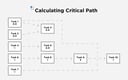
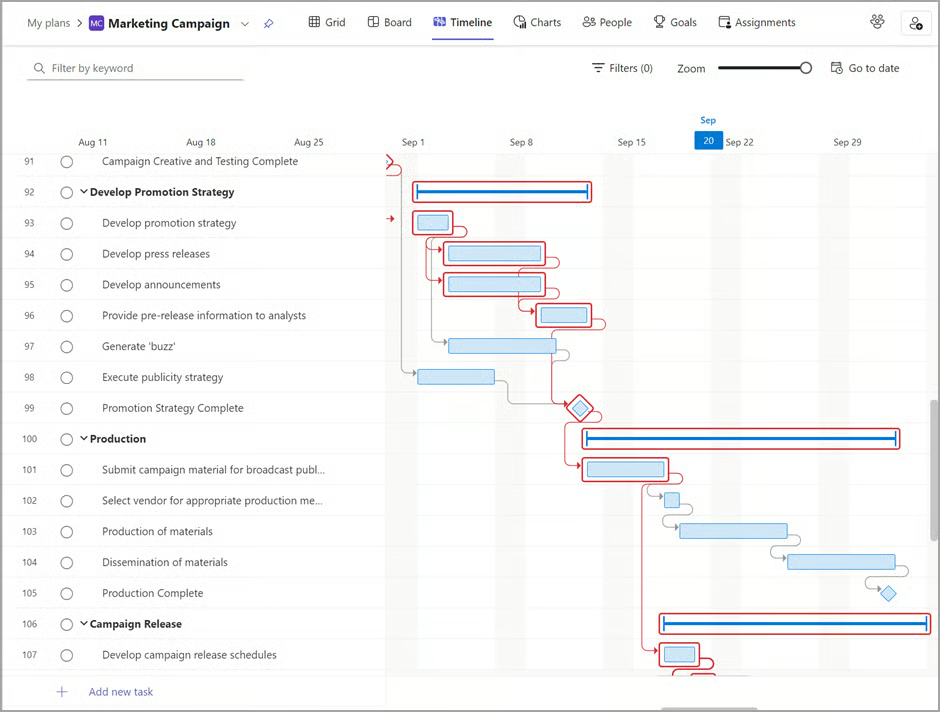
If your team already works in Microsoft 365, I recommend using Microsoft Planner as your primary Gantt chart software. With a premium plan, I can identify the tasks that determine the project’s finish date and add task durations and dependencies in the timeline view.
Adding the critical path filter lets me highlight the sequence of tasks that controls the project’s completion date. As deadlines or dependencies change, Planner recalculates the critical path so I can quickly see priority work.
The downside: Critical path analysis is not available in Planner Plan 1. It requires upgrading to Project Plan 3, which includes advanced features that small teams may not need. ClickUp is a better option when the primary requirement is dependency-based scheduling and occasional critical path analysis without paying for a higher plan.
Pros
Cons
Key features
- Portfolios: Combine project plans and review completion, status, milestones, and deliverables
- Task history: Review who changed assignments, progress, dates, or task information
- Sprints: Organize backlog work into fixed delivery periods for agile teams
- Planner Agent: Generate plans and task lists from project goals and reference files
Pricing
- Free plan: Basic Planner is included with eligible Microsoft 365 subscriptions and includes shared tasks, file attachments, board and schedule views, and Microsoft app integrations.
- Free trial for paid plans: One month
- Planner Plan 1: $10/user/mo. – Includes Timeline and Gantt views, task dependencies, project goals, and reporting dashboards.
- Planner and Project Plan 3: $30/user/mo. – Includes baselines, critical-path scheduling, resource request capabilities, and the Project desktop application.
All quotes above are billed annually.
AI pricing note: Copilot requires a separate Microsoft 365 Copilot license
Read our full Microsoft Planner review.
How to choose the best Gantt chart software
Ready to pick the best Gantt chart software? Before you commit to a free trial, here are five checks I recommend:
Change one dependent task: Move an early task several days forward and watch what happens to connected tasks. An effective Gantt chart tool should recalculate affected dates while letting you control which tasks move, since automatic rescheduling can create unwanted changes when deadlines are fixed.
Test resource capacity across projects: Allocate a workload that surpasses an individual’s available capacity. Check whether the Gantt software flags the conflict across all projects and whether you can reassign work from the workload view.
Review planned versus current dates: Save an original schedule, change several deadlines, and generate a status report. The report should show where dates changed, how much they moved, and which milestones are at risk without requiring you to compare separate exports.
Check stakeholder access: Share the schedule with an external user. Confirm whether clients can view current dates, leave comments, or update selected information without receiving editing rights.
Calculate the subscription cost: Check the plan that includes the scheduling capabilities you will actually use, not the lowest advertised tier. Baselines, workload planning, portfolio reports, guest access, automation, and AI may require upgrades or add-ons that substantially increase the final cost.
FAQs
Is there free Gantt chart software?
Yes. Smartsheet and Zoho Projects offer free plans, but these may limit projects, users, tasks, or advanced scheduling features. Confirm whether the free version includes dependencies, milestones, exports, and collaboration capabilities.
Is Gantt chart software better than Excel?
Gantt software is better used when schedules change frequently, or several people update the plan. Unlike a spreadsheet, it can connect dependent tasks, recalculate dates, preserve baselines, and notify assignees when work changes.
What is the best Gantt software?
The best Gantt software depends on your projects. GanttPRO suits schedule and cost planning, TeamGantt simplifies client sharing, while full-featured platforms such as ClickUp, monday.com, and Smartsheet connect Gantt chart tools with automation and reporting.