





















ClickUp and Jira may compete for the same project management budget, but they are built for very different kinds of work. ClickUp is more versatile and easier to use across project environments, while Jira is more specialized for Agile software development. As someone who has used both, I’ll compare ClickUp vs Jira across pricing and core features to help you decide which one suits your workflow
 |  | |
|---|---|---|
| My rating | 4.72 out of 5 | 4.69 out of 5 |
| Best for | General project management across different types of work | Agile software development and product teams |
| Starting price(billed annually) | $7/user/mo. | $9.05/user/mo. |
| Task and work management | Task hierarchy, custom fields, recurring tasks, dependencies, and multiple work views | Work-item management built around stories, bugs, epics, and dev workflows |
| Agile project management | Sprints, Scrum-style workflows, Kanban boards, and sprint reporting | Native backlogs, Scrum and Kanban boards, sprints, story points, and Agile reports |
| AI and automation | AI agents, AI fields, summaries, task creation, and workflow automations | AI-assisted work creation, summaries, agents, and automation generation |
| Team collaboration | Docs, Whiteboards, Chat, comments | Comments and project collaboration |
| Ease of use | Intuitive, although extensive customization adds a learning curve | Familiar to Agile and dev teams, but use of jargon can take longer for beginners to learn |
Featured Partners: Project Management Software
Project-Management.com may receive a commission from merchants for referrals from this website
How I compared ClickUp vs Jira
I evaluated ClickUp and Jira using a five-point weighted rubric to reflect how buyers compare project management software, with more weight given to the areas that affect everyday use and long-term value.
Pricing (20%): I compared free-plan availability, starting fees, and the range of feature inclusions per plan. I also looked at total ownership cost, including whether niche capabilities require add-ons or a higher subscription tier.
General features (25%): I compared core features such as task management, collaboration, project views, and workflow automation. This category has the highest weight because these tools cover most day-to-day project management needs.
Advanced and niche features (20%): I assessed portfolio management, capacity planning, advanced scheduling, Agile tools, reporting, and AI-assisted work. I gave higher scores when these features were built into the platform and could support more demanding project planning and execution.
Ease of use (10%): I considered setup effort, navigation, and how quickly new users can get comfortable with the platform. I also reviewed recent G2 and Capterra feedback for recurring comments about usability and configuration.
Support (10%): I compared available support channels, community resources, security documentation, and learning materials. Higher scores went to platforms with real-time support access and extensive self-service resources.
Expert score (15%): I based this score on feature depth, pricing value, and the quality of each vendor’s documentation, then compared those findings with third-party ratings. I also considered how clearly each provider explains plan limits and feature availability.
Why you should trust Project-management.com
As a tech analyst for project management software, I have tested nearly 20 platforms over the past five years, and several have become part of my workflow. I have written dozens of buyer’s guides covering a wide range of use cases and company sizes, which gave me a broader understanding of what project teams need from these tools.
Marianne Sison
Senior Staff Writer for Project Management

What Is ClickUp?
ClickUp is an AI-powered work management platform that brings tasks, projects, documents, and team communication into one workspace. You can organize work in lists, boards, calendars, or Gantt charts, while custom fields and statuses give teams the flexibility to adapt the setup for different project types.
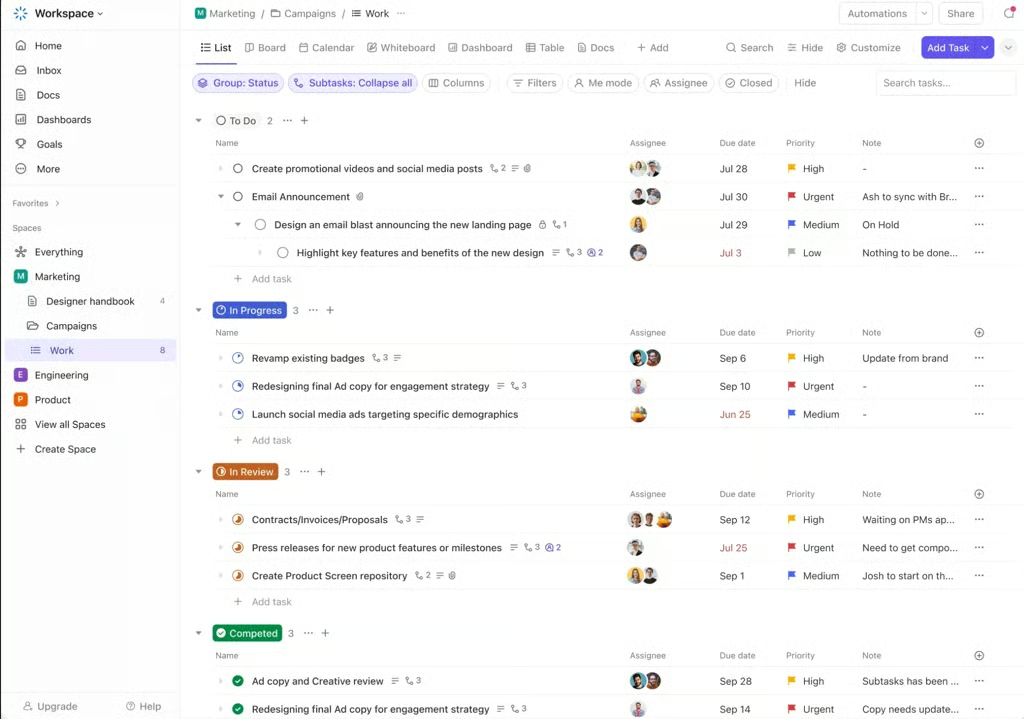
The platform packages much of its functionality through its AI engine, ClickUp Brain. It summarizes project activity, drafts content, answers questions about workspace information, and helps create tasks or updates.
What Is Jira?
Jira is Atlassian’s project management software designed for Agile workflows and software development projects. It supports backlog management, sprint planning, issue tracking, roadmaps, and custom workflows, so it is especially popular with dev and product teams.
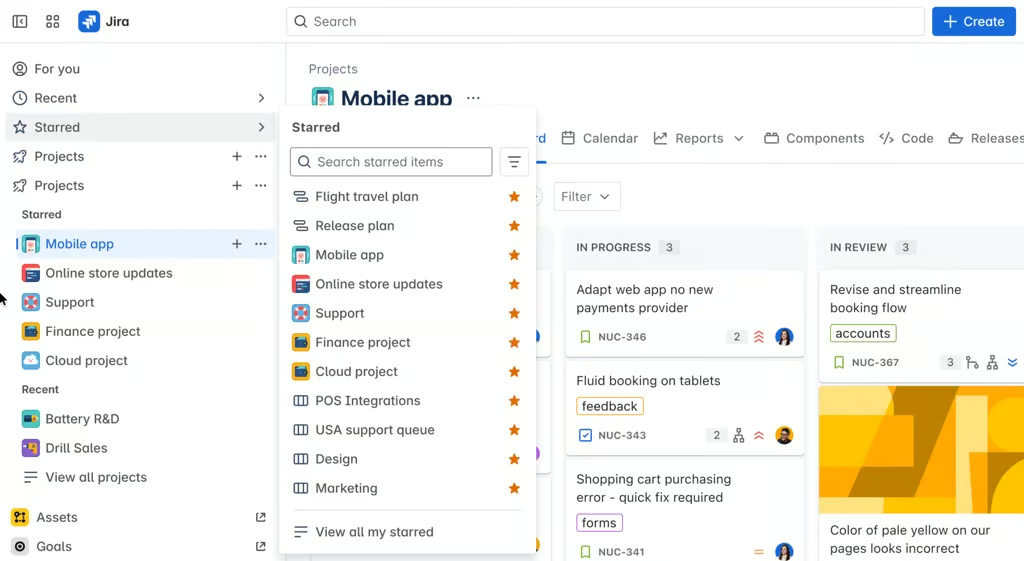
Jira also connects with other Atlassian products such as Confluence and Bitbucket. For software teams, this means project issues can stay connected to technical documentation, code changes, and release activity.
ClickUp & Jira: Pros & cons
| ClickUp | Jira |
|---|---|
| PROS | |
| • Extensive customization for tasks and workflows • Project planning across Gantt, Calendar, and workload views • Native Docs, Whiteboards, and Chat support team collaboration • ClickUp Brain provides AI assistance across the workspace | • Built-in Scrum and Kanban tools • Tools for organizing backlogs and planning sprints • Extensive Agile reporting, including burndown and velocity reports • Highly customizable workflows for software development processes |
| CONS | |
| • The number of available features can feel overwhelming for new users. • Workspace configuration may require more initial setup • Some advanced features and AI capabilities require paid plans or add-ons | • Use of Agile terms can be harder for most users to learn • Advanced planning capabilities require higher-tier plans • Documentation capabilities rely on other Atlassian products such as Confluence |
Pricing
ClickUp wins for pricing because all its plans are relatively cheaper than Jira while still covering a wide range of project management needs. Both platforms offer free plans, but ClickUp gives general project teams more functionality at a lower starting price. For Agile teams, Jira can be the more economical choice for built-in AI access alongside development-focused tools.
| Plan level | ClickUp | Jira |
|---|---|---|
| Free | $0 for unlimited users | $0 for up to 10 users |
| Entry paid plan | $7/user/mo. | $9.05/user/mo. |
| Higher paid plan | Business: $12/user/month, billed annually | Premium: $18.50/user/month |
| Enterprise | Custom pricing | Custom pricing |
| AI | Brain AI starts at $9/user/month; Everything AI costs $28/user/month | Rovo Search, Chat, Agents, and integrated AI features are included with Standard and higher plans |
| AI usage | Brain AI includes 1,500 AI Super Credits per user; more advanced AI capabilities vary by package | Rovo usage credits vary by plan |
Prices shown are current published rates as of September 2026.
Jira is more appealing if your team expects to use AI regularly. Rovo is included with Jira’s paid plans, so Standard users get access to AI search, chat, agents, and assisted work creation as part of the subscription. ClickUp charges separately for Brain AI, which starts at $9 per user per month, while more advanced AI features come with higher-priced options.
Task & work management
ClickUp takes the win for task management tools as it supports a wider range of business processes. You can break work into subtasks and checklists, add custom fields, set dependencies, create recurring tasks, estimate time, and assign work to multiple people. Custom task types and statuses also allow users to adapt the workspace to different kinds of projects.
Jira covers many of the same basics through work items, subtasks, and fields, but its setup is more geared toward software delivery. Work items can represent bugs or stories, while backlogs and sprint workflows help development teams organize upcoming work, set priorities, and decide what goes into each sprint.
| Capability | ClickUp | Jira |
|---|---|---|
| Tasks and subtasks | Yes, including nested subtasks | Yes |
| Custom fields | Yes | Yes |
| Custom work types | Custom task types | Custom work item types |
| Multiple assignees | Yes | More limited by workflow setup |
| Recurring work | Native recurring tasks | Typically handled through automation or configuration |
| Dependencies | Yes | Yes |
| Time estimates | Yes | Yes |
| Project views | List, Board, Calendar, Timeline, Gantt | Board, Calendar, Timeline, backlog |
| Scheduling | Gantt, Timeline, dependencies, milestones | Timeline, dependencies, Plans on higher tiers |
ClickUp also has an edge when those tasks need to roll up into project planning and scheduling. Project managers can switch between List, Board, Calendar, Timeline, and Gantt views, then use start dates, due dates, milestones, and time estimates to plan the work. Jira offers Timeline views and dependencies too, although cross-project planning is available on higher-tier plans.
Agile project management
Jira is the obvious winner here because Agile software development is central to how the platform works. Teams can manage backlogs, plan sprints, estimate effort, and track progress through Scrum or Kanban boards. It also supports Scrumban and Kanplan for combining sprint-based and continuous-flow methods.
| Capability | Jira | ClickUp |
|---|---|---|
| Scrum boards | Yes, with backlog, sprint planning, story points, and burndown reports | Yes |
| Kanban boards | Yes, with native Agile board features | Yes, through Board view |
| Backlog management | Yes, with story prioritization and backlog progress tracking | Yes |
| Sprint planning | Yes | Yes |
| Work estimation | Story points and other estimation methods | Sprint points |
| Sprint rollover | Sprint-based backlog management | Automated unfinished-work rollover |
| Agile reporting | Burndown, velocity, cumulative flow, sprint reports, and additional Agile reports | Burndown, burnup, velocity, cumulative flow |
| Development integrations | Integration with Atlassian dev tools and integrations | GitHub, GitLab, Bitbucket |
ClickUp is a better choice for teams that use Agile but want the familiarity of a general-purpose project management platform. Its Sprints feature covers sprint dates, point estimates, priorities, and unfinished-work rollover, while Board view supports Scrum or Kanban-style workflows. Teams can also track sprint performance with burndown, burnup, velocity, and cumulative flow reports.
AI & automation
ClickUp comes out ahead because its AI tools support a wider range of project work. With ClickUp Brain, you can summarize tasks, draft updates, create subtasks, search workspace content, and get writing help inside Docs or tasks. AI Fields can pull out summaries or action items from task data, while automations and agents can take care of routine workflows or multi-step processes.
Rovo powers Jira’s AI features and connects with the rest of the Atlassian ecosystem. It can summarize work items, suggest subtasks, search project information in plain language, and create automation flows from prompts. Jira also supports AI agents within workflows, but ClickUp gives you more ways to use AI across task management, documentation, enterprise search, and workflow automation.
Reporting & project visibility
ClickUp and Jira are evenly matched, but they serve different reporting needs. Jira’s reporting toolkit is geared toward Agile delivery, so software teams can get clearer insight into sprint health and delivery trends. ClickUp, on the other hand, is easier to use if your reporting needs span project status, workload, time, or client-facing updates.
| Capability | ClickUp | Jira |
|---|---|---|
| Custom dashboards | Yes, with configurable cards and filters | Yes, with customizable gadgets |
| Agile reporting | Burndown, burnup, velocity, cumulative flow | Broader set of Scrum and Kanban reports |
| Workload reporting | Yes | Yes |
| Time tracking reports | Yes | Yes |
| Forecasting | Available through dashboard data and project metrics | Dedicated forecast and management reports |
| Issue/work analysis | Custom dashboard reporting | Dedicated issue analysis reports |
| Stakeholder sharing | Shareable dashboards with permissions | Shared dashboards |
| Drill-down reporting | Yes | Yes, through reports and searches |
Jira gives you several ways to dig into project performance, from burndown and velocity reports to workload, issue trends, and forecasting. You can also bring data from multiple projects into dashboards and reuse saved searches for more focused monitoring. Meanwhile, ClickUp focuses on dashboard flexibility, with cards for charts, workload, time tracking, and other project metrics.
Ease of use
ClickUp is generally easier to pick up for project teams that do not work in software development. Its List, Board, Calendar, and Gantt views feel familiar, and common task actions are easy to access once the workspace is set up. Still, ClickUp gives users a lot of options, so the number of menus and settings can take some time to learn.
Jira feels more familiar for Agile and dev teams, although its terms such as epics, backlogs, issues, and sprints may be less intuitive for general business users.
| ClickUp | Jira | |
|---|---|---|
| Initial setup | Guided, but highly customizable | More process-driven |
| Navigation | Several views and menu options | More focused on Agile workflows |
| Terminology | General project management language | More Agile and development-specific |
| Customization | Extensive | Extensive, with more emphasis on workflows |
| Learning curve | Moderate | Moderate to steeper for nontechnical users |
After the initial learning period, ClickUp becomes more user-friendly for project work. Users can switch views, update tasks, and adjust statuses with fewer technical concepts to learn first. Jira can be easier for teams that already use Scrum or Kanban, since its navigation follows standard Agile practices.
ClickUp & Jira alternatives
If ClickUp feels too overwhelming and Jira is too Agile-focused, monday.com, Wrike, and Zoho Projects offer different ways to manage project work. monday.com is better for visual planning, Wrike is geared toward teams with more review processes, and Zoho Projects supports businesses that track billable work.
| Alternative | Best for | Why consider it instead of ClickUp or Jira? |
|---|---|---|
| monday.com | Visual project management | Uses customizable boards, dashboards, automations, and multiple project views. It can be easier to scan for teams that want a more visual way to manage work. |
| Wrike | Client work and review processes | Includes request forms, approvals, proofing, workload management, time tracking, and Gantt charts. It is worth considering if your projects involve frequent reviews or external stakeholders. |
| Zoho Projects | Billable project work | Combines task management with timesheets, billing rates, budget tracking, and integrations with Zoho Books and Zoho Invoice. It works for service businesses that bill clients for project time. |
ClickUp vs Jira: Which one should you choose?
In this Jira vs ClickUp battle, ClickUp is the better choice for teams that need one platform to manage different kinds of projects. It covers task management, project planning, collaboration, reporting, and AI in a way that works across business functions.
Jira has a narrower focus, but that works in its favor for software teams. Its Agile tools are more specialized for backlog prioritization, sprint planning, issue tracking, and development workflows.
The final choice depends on whether your priority is general project management or Agile software delivery.
Choose ClickUp if:
- You manage a mix of project types across different teams.
- You want planning, task management, docs, and collaboration in one place.
- You prefer a more general-purpose project management platform.
- You want AI features that support a wider range of project work.
Choose Jira if:
- Your work is centered on software development or product delivery.
- You rely heavily on Scrum or Kanban.
- You need detailed Agile reporting and backlog management.
- You already use other Atlassian products.
FAQs
Is ClickUp better than Jira?
ClickUp is generally better for teams that manage a wide mix of projects, while Jira works for Agile software development. ClickUp offers broader work management tools, whereas Jira provides built-in support for sprints, backlogs, and development workflows.
Is ClickUp easier to use than Jira?
ClickUp is usually easier for general project teams because its interface and terminology are less technical. Jira can feel more intuitive for experienced Scrum or Kanban teams, but nontechnical users may need more time to learn its workflow concepts.
Which is cheaper, ClickUp or Jira?
ClickUp generally has a lower starting price for paid plans, which can make it more cost-effective for general project management. Jira may offer better value for software teams that can make full use of its Agile features and included AI capabilities.