























- Key takeaways
- What is a RACI matrix?
- RACI matrix example: Campaign approval workflow
- Free annotated RACI matrix
- When should you use a RACI matrix?
- How to create a RACI matrix
- How to check if your RACI matrix works
- RACI matrix examples & templates
- How to turn a RACI matrix into a live project workflow
- Common RACI mistakes & how to avoid them
- RACI matrix vs other frameworks
- FAQs
Key takeaways
 RACI assigns four distinct roles to project work: Responsible performs the work, Accountable owns the outcome, Consulted provides required input, and Informed receives updates.
- Each deliverable should have one Accountable owner, while multiple people can be Responsible. Consulted and Informed roles should appear only when their involvement is necessary.
- An effective RACI matrix exposes role and ownership issues before work begins. Missing owners, too many approvers, or one person carrying several major responsibilities can signal likely delays or workload issues.
Every project reaches a point where roles blur. Who makes the final call? Who’s actually doing the work? In project management, a RACI matrix maps out exactly who is responsible, accountable, consulted, and informed for every task.
If you’re new to it, this guide explains how to build one, with examples to get you started.
What is a RACI matrix?
A RACI matrix is a project management tool that clarifies task ownership by defining each team member’s role in completing a task.
The RACI framework — sometimes called the RACI model or RACI diagram — is used for determining project roles to improve workflows and communication. It breaks down what roles individuals will play as work is carried out and to what extent they will be involved in the project overall. The horizontal axis represents each person on the project team, and the vertical axis represents each task.
Each square of the matrix represents an individual, a task, and that individual’s role within the project, either responsible, accountable, consulted, or informed. By assigning these roles, project managers prevent confusion and overlapping duties while increasing accountability.
What does RACI stand for?
RACI stands for Responsible, Accountable, Consulted, or Informed, with each designation clarifying a team member’s responsibilities within the project. Below are the four core roles of RACI, with the required number of assignees and examples.
| RACI role | Description | Number of assignees | Examples |
|---|---|---|---|
| Responsible (R) | Carries out the work required to complete a task or deliverable | One or more, with each person's contribution defined | • Copywriters • Graphic designers • Developers |
| Accountable (A) | Owns the outcome and ensures the task meets expectations | One person per task | • Product owners • Project manager • Team supervisor |
| Consulted (C) | Provides input or expertise before or during the project | One or more people | • Legal experts • Subject matter expert • Financial advisor |
| Informed (I) | Receives updates on progress or final outcomes | One or more people | • Committee members • Clients • External partners |
Responsible
The Responsible person is the one doing the actual work. They own the task from start to finish, take a hands-on approach to execution, and make sure the deliverable is completed on time. In most cases, a task has one Responsible person, though larger tasks can have more. What stays consistent is that this person is expected to produce the output, not just oversee it. If something isn’t moving, they’re the first point of contact.
Accountable
The Accountable person is the final check on a deliverable. They review the work, confirm it meets the required standard, and give the sign-off. There should only be one Accountable per task. In a RACI matrix, designating this role removes ambiguity around who has the authority to approve and move things forward.
Consulted
The Consulted role covers anyone whose input is needed before a task can progress. This could be a legal team, a technical lead, or, in the case of a large expansion, much of the organization. Their recommendations inform decisions, but the project team isn’t obligated to follow them.
Informed
The Informed group doesn’t make decisions or get consulted, as they simply need to know what’s happening. This is usually business owners or stakeholders who care about overall progress. Include them in kickoffs and demos as optional attendees, and keep them copied on major updates.
RACI matrix example: Campaign approval workflow
Consider a campaign asset that moves through production, stakeholder review, final approval, and media release. A RACI matrix shows who completes each step, who approves the outcome, and who only needs to provide input or receive updates.
| Deliverable or decision | Project manager | Creative lead | Client stakeholder | Media lead | Executive sponsor |
|---|---|---|---|---|---|
| Define asset requirements | A | R | C | C | I |
| Produce first draft | A | R | C | I | I |
| Review campaign messaging | R | C | A | I | I |
| Approve final asset | C | R | A | I | I |
| Release asset to media | I | C | I | R | A |
Why these assignments matter
Responsible and Accountable serve different purposes. The creative lead produces the asset, while the client stakeholder approves its content. Separating execution from final ownership tells the team who does the work and who can authorize the result.
Each deliverable has one Accountable owner. When several stakeholders can approve the same work, conflicting feedback can leave the project manager unsure which direction takes priority. One Accountable assignment identifies who has the final say.
Consulted does not create another approval step. A subject matter expert or media lead may provide input before work continues, but they do not automatically gain approval authority. This keeps required feedback separate from the final decision.
Free annotated RACI matrix
Download the campaign approval RACI used in the example above. The workbook includes the completed matrix, notes explaining key role assignments, and a blank version you can adapt to your own project.
When should you use a RACI matrix?
Use a RACI matrix when several people contribute to the same deliverable and ownership could become unclear. It works best when a project involves multiple departments, repeated approvals, or decisions that require input from several stakeholders.
| Situation | Use RACI? | Why |
|---|---|---|
| Several departments share a deliverable | Yes | Clarifies who does the work and who owns the final outcome |
| Multiple reviewers delay progress | Yes | Separates required input from final approval authority |
| Responsibilities are unclear at project kickoff | Yes | Defines who participates before work begins |
| A small team already has obvious roles | Usually no | The matrix may add maintenance with little additional clarity |
| You need to show process sequence | No | A process map or swimlane diagram shows handoffs and workflow order more clearly |
| The main issue is decision authority | Consider another method | DACI or RAPID focuses more directly on who drives and approves decisions |
When RACI adds unnecessary work
RACI may only add extra work when a small team already understands who owns each task and who approves the work. In those cases, clear task assignments in the project plan may provide enough direction.
It can also become difficult to maintain during exploratory work where responsibilities change frequently as the team tests ideas or adjusts scope. If the matrix needs constant revision to reflect temporary assignments, a flexible task board or decision log may be easier to keep current.
How to create a RACI matrix
A RACI matrix should cover deliverables and decisions where more than one person could reasonably assume ownership or approval authority. Include work where role confusion could delay completion, duplicate effort, or leave a decision unresolved.
1. Define the project scope
State the project goal and the work included in it before assigning roles. Defining these boundaries keeps unrelated responsibilities out of the matrix and gives the team a shared basis for deciding which work needs an owner.
2. Choose the deliverables that need ownership
Add rows for major deliverables and approvals. Include decisions when several people could reasonably expect to own the outcome or authorize the next step, but leave out minor tasks that already have an obvious assignee.
3. Identify the roles involved
List the job roles or named individuals who participate in the work covered by the matrix. Use job titles when responsibility stays with the position even if the person holding that role changes during the project.
4. Assign one Accountable owner
Assign one person to each row who owns the final result and has authority to approve or escalate it. Do this before assigning Responsible contributors so the team settles final authority before deciding who performs the work.
5. Assign Responsible contributors
Mark the people who will perform the work as Responsible. One person may be enough for a smaller deliverable, while larger deliverables can have several Responsible contributors as long as each person's part is defined.
6. Add Consulted and Informed only where needed
Use Consulted when someone's input is required before work or approval can move forward. Use Informed when someone needs the outcome or a status update, and leave the cell blank when the person has no role in that activity.
7. Review the RACI matrix with the team
Have each assigned person confirm their role before project work begins. Check that every Accountable owner has decision authority and that Responsible contributors know which part of the deliverable they own. Update the matrix when project scope changes or responsibility moves to another person.
If you need more information on how to create a RACI matrix, there are several RACI training courses and other resources you can use to get started.
Need a starting point? Download our free annotated RACI matrix and blank template.
How to check if your RACI matrix works
A completed RACI matrix still needs a review before the project starts. Check each row for missing ownership, then scan each person's column for assignments that may overload one person or delay approvals
Check every row for ownership problems
Review the matrix horizontally, one deliverable at a time. Each row should show who performs the work and who owns the final outcome, while Consulted and Informed roles should appear only when they are needed.
| What you see | What it may indicate |
|---|---|
| No Responsible role | Nobody has been assigned to complete the work |
| No Accountable role | Nobody owns the final outcome |
| More than one Accountable role | Final approval authority is divided |
| Too many Consulted roles | Reviews may slow decisions or handoffs |
| Informed assigned to nearly everyone | Routine status reporting may be a better option |
| Every cell contains a role | Some people may be included even when they have no involvement |
Check each role for workload and approval bottlenecks
Next, review the matrix vertically by scanning each person's column. If one person is Responsible for several overlapping deliverables, the workload may be unrealistic; if the same person is Accountable for most rows, approvals could depend too heavily on one individual.
Also look for people marked Consulted across a large share of the matrix. Requiring the same stakeholder's input on many activities can create recurring review delays, especially when several deliverables reach that person at the same time.
Verify assignments against real authority
The Accountable role should go to someone who can approve the outcome or escalate issues when work cannot move forward. Assigning an A in the matrix does not give a person authority they do not already have within the organization.
Compare the matrix with actual reporting lines and approval rules before finalizing it. If the assigned owner cannot approve the work, change the assignment or confirm who holds that authority before the project begins.
RACI matrix examples & templates
Integrating the RACI matrix into project management software makes it easier to assign roles and responsibilities. In fact, a number of project management software solutions offer free RACI matrix templates in different formats. Here are just a few we found:
1. monday work management
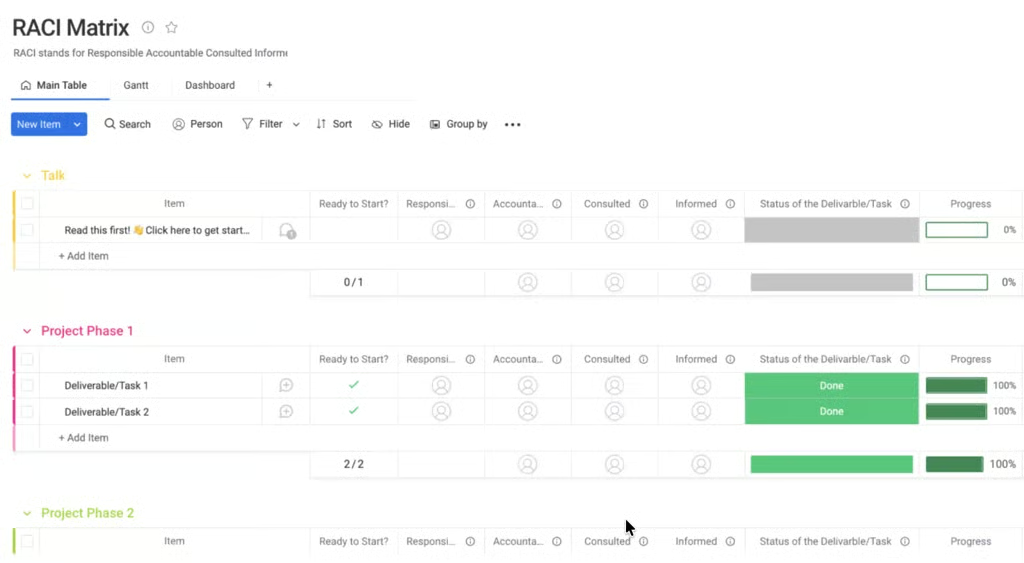
This monday.com RACI matrix combines role assignments, task status, and progress tracking in a single workspace, with a dedicated field for each RACI role. Its visual layout makes it suitable for beginners because responsibilities, task progress, and project phases are displayed in a straightforward table that is easy to understand at a glance.
2. ClickUp
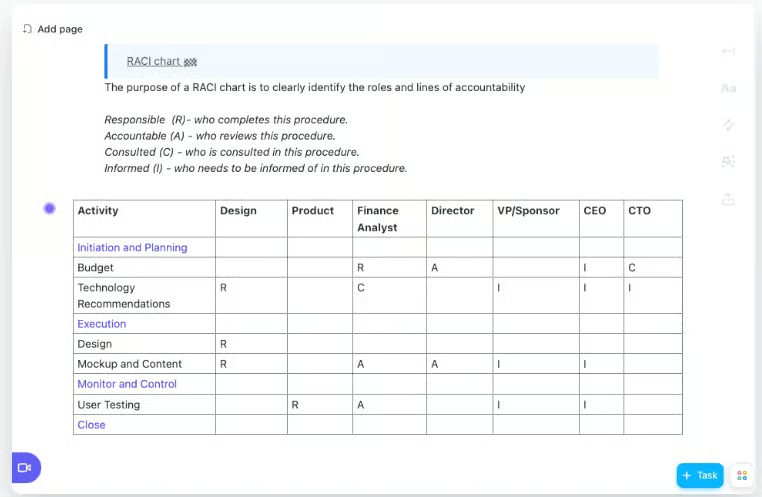
This ClickUp RACI matrix organizes responsibilities by project phase and stakeholder role, helping teams define ownership from project initiation through execution, monitoring, and closure. I highly recommend this template for governance-heavy projects because it connects project activities with decision-makers and subject matter experts.
3. Smartsheet
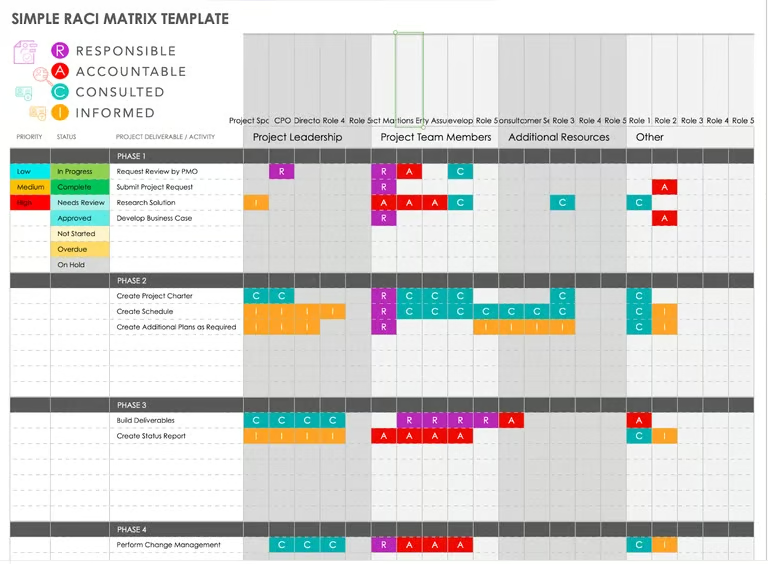
This RACI analysis matrix from Smartsheet maps project activities across multiple phases and stakeholder groups. By visualizing role assignments at the task level, teams can identify issues in ownership, prevent overlapping responsibilities, and improve decision-making throughout the project lifecycle. I find this format effective for complex projects because it combines governance, stakeholder communication, and project execution into a single view.
4. Wrike
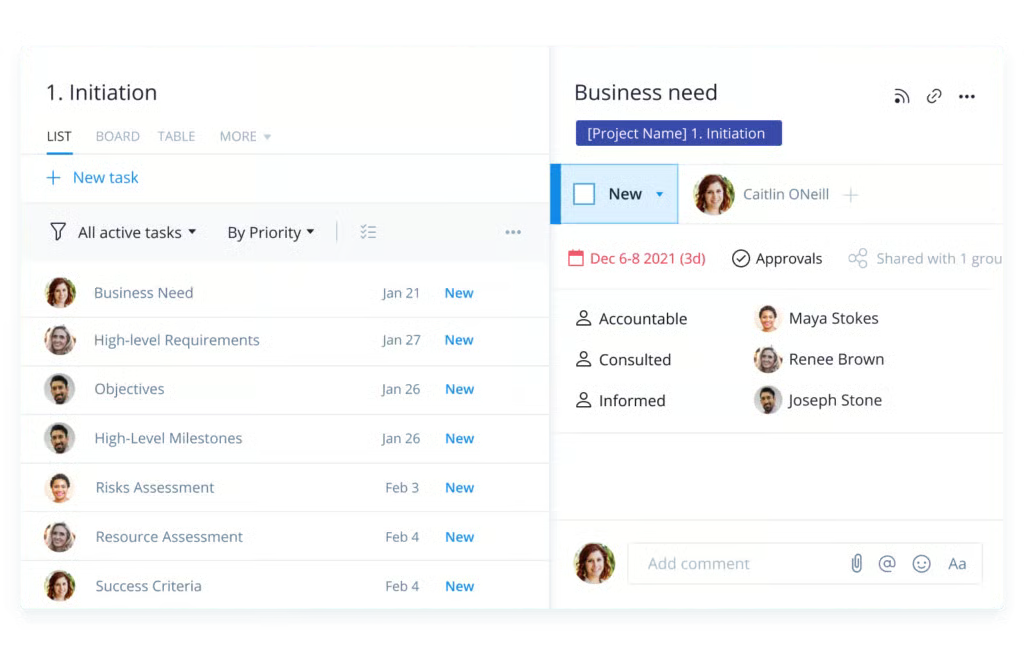
Wrike’s RACI chart embeds accountability within each task, making it easy to see who owns the work, who provides input, and who needs status updates. In this RACI matrix example, the “Business Need” task assigns Accountable, Consulted, and Informed stakeholders within the task record, creating a clear chain of ownership and communication from project initiation onward. I find this approach useful for cross-functional projects because role assignments remain connected to the work itself.
How to turn a RACI matrix into a live project workflow
Keep RACI assignments inside the project management system where your team tracks the related deliverables. This reduces the chance that a separate RACI chart becomes outdated when responsibilities or project work change.
For each deliverable in the matrix:
- Create a corresponding task or item. Use the same deliverable name so people can match the project work to the RACI.
- Add the RACI roles. Assign Responsible and Accountable first, then add Consulted or Informed where their involvement is required.
- Connect the assignment to the work. Keep the due date and current status beside the RACI roles so people can see who performs the work and who can approve it.
For example, monday.com’s RACI template combines role assignments with project phases and task status. A team using the campaign example above could create separate items for the first draft and messaging review, then add final approval and media release as later deliverables.
The project tool should record authority that the team has already agreed on. If someone is marked Accountable but cannot approve or escalate the deliverable within the organization, revise the RACI assignment before using it to manage the project.
Common RACI mistakes & how to avoid them
- Starting without a project plan: Don’t build a RACI matrix before you have a full team, a defined scope, and a project plan.
Starting with a project plan serves as your foundation for assigning responsibilities and ensures the matrix reflects project objectives. - Adding too many stakeholders: The bigger the team, the harder the matrix is to manage. Too many roles and stakeholders make responsibilities harder to track and accountability easier to dodge. For large teams, break the project into smaller components or consider creating separate RACI matrices for individual workstreams or project phases to keep ownership clear.
- Failing to communicate roles: A RACI matrix doesn’t replace a conversation. Before finalizing it, brief the team on their roles and the project’s goals. Hold a kickoff meeting and revisit the matrix regularly so no one loses track of their responsibilities as the project evolves.
- Overburdening team members: Avoid stacking multiple Responsible and Accountable roles on one person. It leads to burnout and slower output. Review the matrix regularly to make sure workload is distributed evenly across the team.
RACI matrix vs other frameworks
RACI clarifies task ownership and stakeholder involvement, while other frameworks such as RASCI, DACI, and RAPID can define decision authority or connect responsibilities to the project plan. The right method depends on whether you need clearer accountability and approvals.
Several RACI alternatives may be more suitable depending on your project’s needs:
| Method | Primary purpose | When to use it |
|---|---|---|
| RASCI | Adds a Support role to RACI | Use when the person completing a task needs help from another contributor. |
| DACI | Assigns a Driver, Approver, Contributors, and Informed parties | Use when one person must move a decision forward while another grants final approval. |
| RAPID | Defines who Recommends, Agrees, Performs, provides Input, and Decides | Use for major decisions that require several types of authority or expertise. |
- RASCI: Adds a Support role to the traditional RACI structure, providing extra assistance where necessary.
- DACI: The DACI framework focuses on decision-making by identifying clear Decision Makers and those accountable for final outcomes.
- RAPID: A decision-making framework that defines who Recommends, Agrees, Performs, Inputs, and Decides on critical decisions.
FAQs
Can one person be Responsible and Accountable in a RACI matrix?
Yes. One person can be both Responsible and Accountable when they perform the work and have the authority to approve the final result. This arrangement is more common on smaller deliverables where execution and final ownership naturally belong to the same role.
Can a RACI matrix have multiple Responsible people?
Yes. A deliverable can have several Responsible contributors when more than one person performs the work. Define each contributor's part of the deliverable so the assignment does not create duplicate effort or leave team members assuming someone else will complete it.
Does every row need all four RACI roles?
No. Each row should identify who owns the outcome and who performs the work, but Consulted and Informed roles should appear only when their involvement is required. Leave a cell blank when a person has no role in that deliverable.
Can a RACI matrix have more than one Accountable person?
A RACI row should normally have one Accountable owner. Multiple Accountable assignments can leave the team with competing approval authority and no single person responsible for the final decision. If several people must formally approve the result, document the approval process separately or consider a decision-focused framework.
How often should you update a RACI matrix?
Update the matrix when responsibilities change rather than on a fixed schedule. Revisit it when project scope changes, a role moves to another person, or a new approval requirement changes who can authorize the work.