



















Key takeaways
Agile software development plays a central role in product teams that must deliver updates on time while adapting to changing requirements. Many organizations move away from traditional models like Waterfall because rigid planning increases the risk of delivering features that no longer meet business priorities. To help you understand how Agile works and determine if it fits your workflow, this guide explains Agile principles, major frameworks, key roles, and the tools that support sprint planning.
What is Agile software development?
Agile software development is an iterative approach to building software in short cycles. Instead of planning everything upfront, teams adapt to change and incorporate feedback throughout the project, emphasizing collaboration and customer involvement. Teams break large projects into sprints or iterations, producing a product increment at the end of each cycle.
This method began as a response to the limitations of traditional, linear development methods such as Waterfall. In the 1990s, many software projects ran over budget or failed to meet user expectations because requirements changed faster than documentation could keep up.
In 2001, a group of 17 software practitioners met in Snowbird, Utah, to discuss better ways to develop software. They created the Agile Manifesto, which outlined four values and 12 principles that prioritize individuals, collaboration, working software, and adaptability.
The Agile Manifesto and 12 Principles
At the center of the Manifesto are four core values. Agile teams place greater importance on:
- Individuals and interactions over processes and tools
- Working software over comprehensive documentation
- Customer collaboration over contract negotiation
- Responding to change over following a fixed plan
While the four values define the mindset behind Agile, the 12 principles explain how teams apply that mindset in projects.
- Satisfy the customer through early and continuous delivery of valuable software.
- Welcome changing requirements, even late in development.
- Deliver working software frequently, with a preference for shorter timescales.
- Ensure close, daily collaboration between business stakeholders and developers.
- Build projects around motivated individuals and give them the support they need.
- Communicate face-to-face whenever possible, as it is the most effective way to share information.
- Measure progress primarily through working software.
- Promote sustainable development with a consistent pace over time.
- Maintain technical and design excellence to enhance agility.
- Keep processes simple and focus on the work that delivers real value.
- Encourage self-organizing teams, as they produce the best solutions.
- Reflect regularly on how to become more effective and adjust behavior accordingly.
Together, these principles shape how Agile teams think and operate. They shift the focus from rigid control to steady delivery of working software that meets real user needs.
Who should use Agile methodologies?
Agile software development is best suited for teams and organizations that operate in dynamic environments where requirements are likely to change frequently. This includes software development teams working on complex projects with evolving goals, such as those in the tech industry, startups, or any field where innovation and rapid response to customer feedback are critical.
Teams in industries such as product development, marketing, and any sector facing fast-changing market conditions or technological advancements can effectively leverage Agile methodologies to stay competitive and responsive.
The Agile software development process
The Agile software development process involves iterative planning, incremental delivery, continuous feedback, and regular improvement. Instead of moving through one long sequence of phases, teams cycle through focused stages that repeat throughout the project.
1. Define the product vision
Every Agile project starts with a clear product vision. This explains the problem being solved, the target users, and the expected business value. It guides prioritization decisions and keeps the team focused when requirements evolve.
Example: A fintech company defines its vision as building a mobile budgeting app for young professionals who struggle to track spending. The goal is to increase user retention by 20% within six months. This vision guides feature selection throughout development.
2. Create & prioritize the product backlog
The product backlog is a dynamic list of features, enhancements, fixes, and technical work. The product owner prioritizes items based on expected value and risk reduction, while also considering learning opportunities. Backlog refinement happens throughout the project so that upcoming work aligns with the objectives.
Example: For the budgeting app, the backlog includes user registration, expense tracking, reporting dashboards, and security enhancements. The product owner prioritizes secure login and core tracking features before advanced analytics because those deliver immediate user value.
3. Sprint planning & goal setting
During sprint planning, the team selects backlog items they can complete within a fixed time frame. They break large items into smaller tasks, then define acceptance criteria and a sprint goal. This goal gives stakeholders a clear understanding of what the sprint is meant to deliver.
Example: The team sets a sprint goal to launch basic expense tracking. They select user story items such as “log daily expenses” and “categorize transactions.” Acceptance criteria specify that users must be able to save and edit entries.
4. Sprint execution
The team develops, tests, and integrates the selected work during the sprint. Collaboration is continuous, and progress is shown through task boards or tracking tools. New requests are typically deferred to protect focus, unless urgent changes threaten business value or system stability.
Example: Midway through the sprint, a stakeholder suggests adding investment tracking. The team documents the idea in the backlog but continues focusing on completing the agreed expense tracking functionality.
5. Daily standups
Daily standups are short, timeboxed meetings — typically no longer than 15 minutes — held at the same time each working day during a sprint. Their purpose is to help the team inspect progress toward the sprint goal and adjust plans as needed, not to provide status updates to management.
During the standup, each team member briefly answers three core questions:
- What did I complete yesterday?
- What will I work on today?
- What obstacles or blockers are in my way?
Example: A developer reports a delay due to an API integration issue. Another team member with prior experience offers support, preventing the problem from extending into the next sprint.
6. Sprint review
At the end of the sprint, the team presents the working increment to stakeholders. The review confirms whether the delivered functionality meets expectations and supports business objectives. Feedback gathered during this session directly influences backlog priorities and future direction.
Example: Stakeholders test the expense tracking feature and request more specific category labels. The product owner adds improvements to the backlog for the next sprint.
7. Sprint retrospective & process adjustment
A sprint retrospective allows the team to reflect on what worked and what needs improvement. They identify process adjustments that can increase efficiency or product quality. This step ensures the team evolves with each iteration.
Example: The team notes that unclear requirements slowed development. For the next sprint, they agree to refine backlog items ahead of time and involve the product owner more during planning.
8. Release & continuous delivery
After multiple iterations, increments may be combined into a formal release. Mature Agile teams can deploy after every sprint because they rely on automation and strong testing practices. The goal is to deliver value and expand it steadily over time.
Example:
After three sprints, the budgeting app launches with expense tracking and reporting features. Additional features, such as goal setting, are released in later updates based on user feedback.
Popular Agile development frameworks
Agile software development is supported by several frameworks that turn its principles into repeatable practices. Each framework approaches planning, delivery, and team coordination differently, which makes selection an important decision.
Scrum
Scrum is built around fixed-length sprints that usually last two to four weeks. Work is planned at the beginning of each sprint, and the team commits to delivering a specific goal by the end of that timebox. Scrum relies on inspection and adaptation through sprint reviews and retrospectives, which makes it well-suited for product development where requirements evolve but delivery cadence must remain steady. It works best for cross-functional teams that can dedicate their focus to sprint commitments without constant external interruptions.
Kanban
Kanban focuses on continuous flow instead of timeboxed iterations. Work items move across a visual board, and teams limit active tasks within each stage of the workflow to prevent bottlenecks. Kanban is often chosen by operational teams where incoming work is unpredictable and cannot wait for the next sprint. It allows gradual improvement without major role changes or formal ceremonies.
External Programming (XP)
Extreme Programming concentrates on the engineering discipline and software quality. It promotes short development cycles, frequent releases, and technical practices such as test-driven development and pair programming.
Common XP practices include:
- Pair programming, where two developers work together at one workstation
- Test-driven development (TDD), writing automated tests before production code
- Continuous integration, merging code changes frequently
- Refactoring, improving code structure without changing functionality
- Small, incremental releases
Teams may adopt XP in different ways. Some implement the full set of practices, while others selectively apply techniques like pair programming or TDD to strengthen development standards.
XP is commonly adopted by teams that handle complex systems where defects are costly, and code quality directly affects business performance. Many organizations combine XP with Scrum, using Scrum for workflow management and XP to strengthen development standards.
Dynamic Systems Development Method (DSDM)
Dynamic Systems Development Method, or DSDM, is an Agile framework that focuses on delivering projects on time and within budget while allowing scope to adjust. It fixes cost and schedule, then prioritizes features so the most important requirements are delivered first. DSDM places strong emphasis on active user involvement throughout the project lifecycle. It is often used in organizations that need formal governance and documentation but still want the flexibility of iterative development.
Benefits & challenges of Agile Software Development
The strength of Agile methodology in software development lies in its ability to deliver working products quickly while adapting to changing requirements and incorporating ongoing stakeholder feedback. However, it can struggle in environments that lack strong collaboration or disciplined backlog management. Determining if it is the right choice requires evaluating your team’s maturity, leadership support, and organizational culture.
Benefits of Agile software development
- Delivers working software in short cycles, which allows faster feedback
- Encourages regular stakeholder input throughout the project, reducing the risk of building the wrong features
- Adapts to changing requirements without restarting the entire plan
- Surfaces risks early through frequent reviews and testing
- Stronger collaboration between business and technical teams
Challenges of Agile software development
- Requires continuous stakeholder participation, which can be difficult to sustain
- Demands experienced team members who can work in self-organizing environments
- Requires disciplined backlog management to prevent shifting priorities
- Documentation may not be as extensive as certain industries require.
Agile software development roles & responsibilities
The most common roles associated with Agile delivery, particularly within Scrum, include the product owner, Scrum Master, development team, and stakeholders. Each role carries specific accountability that supports value delivery and team effectiveness.
Product owner
The product owner is a single individual who represents the voice of the customer and is responsible for maximizing product value.
- Owns the product backlog and has final authority over prioritization
- Defines acceptance criteria and ensures backlog items are ready for development
- Balances input from stakeholders while making scope and value decisions
- Accepts or rejects completed work based on expectations
Scrum master
The Scrum Master is one person accountable for maintaining process health and helping the team improve how it works.
- Facilitates Agile ceremonies such as sprint planning, reviews, and retrospectives
- Removes obstacles that block the team’s progress
- Coaches the team on Agile principles and practices
- Protects the team from external disruptions during the sprint
Development team
The development team is a cross-functional group, typically composed of about five to seven members, accountable for delivering working software each sprint.
- Builds and tests product increments during each sprint
- Estimates effort and commits to sprint goals
- Collaborates closely to solve technical challenges
- Ensures that completed work meets quality standards
Stakeholders
Stakeholders ensure the product aligns with business objectives.
- Provide feedback during sprint reviews
- Influence priorities through collaboration with the Product Owner
- Support decision-making that affects scope or direction
Looking to expand your role in Agile software development? Coursera offers online courses that cover Agile methodologies, backlog management, and sprint planning. These courses are available at beginner and intermediate levels, and most programs can be completed in one to three months, depending on your pace.
Agile software development tools
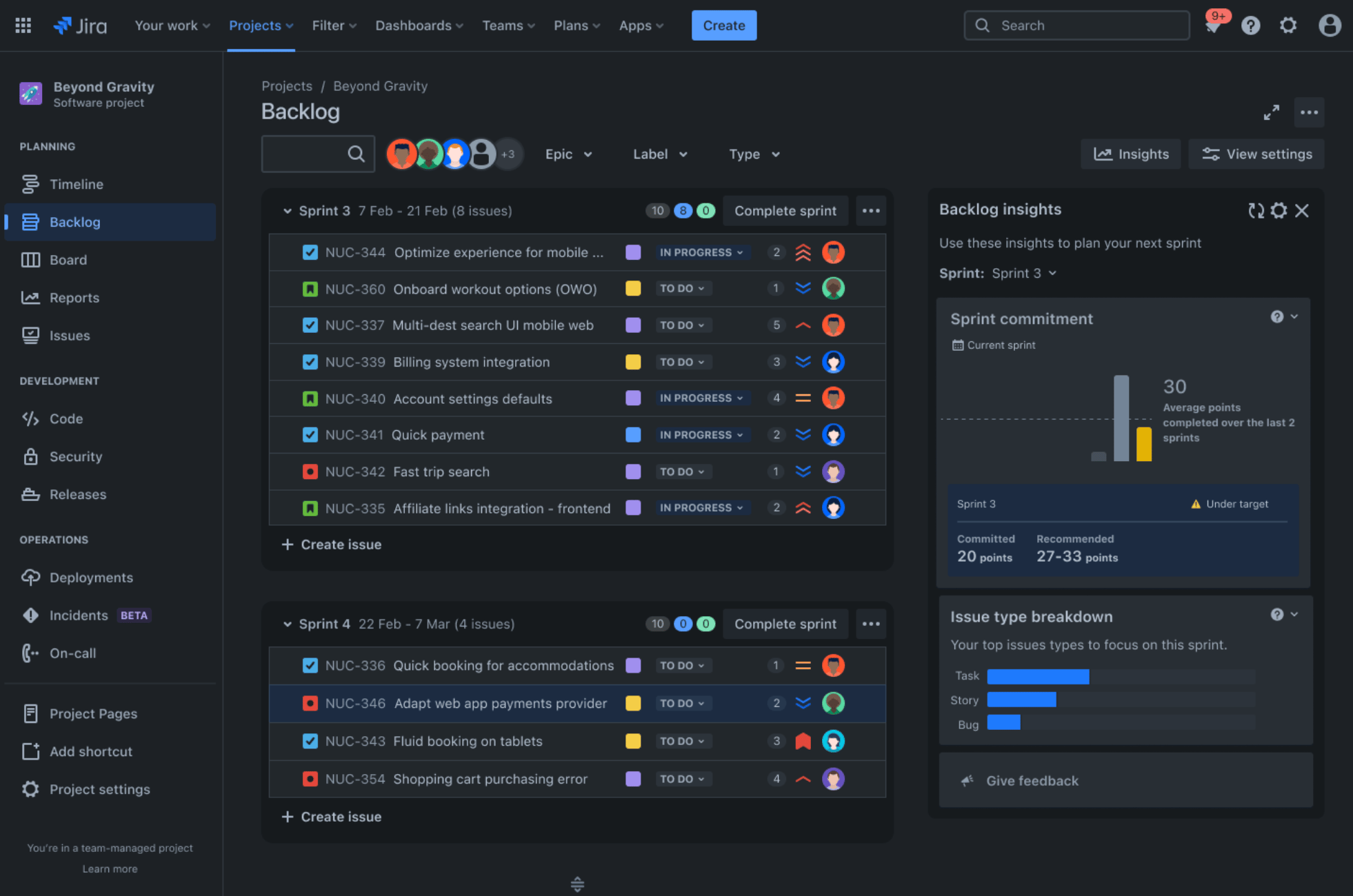
Jira, monday.com, and ClickUp are Agile software development tools that provide a centralized platform where teams can visualize workflow and manage priorities. They offer features that support sprint planning, backlog refinement, issue tracking, and performance measurement within Agile environments.
monday work management
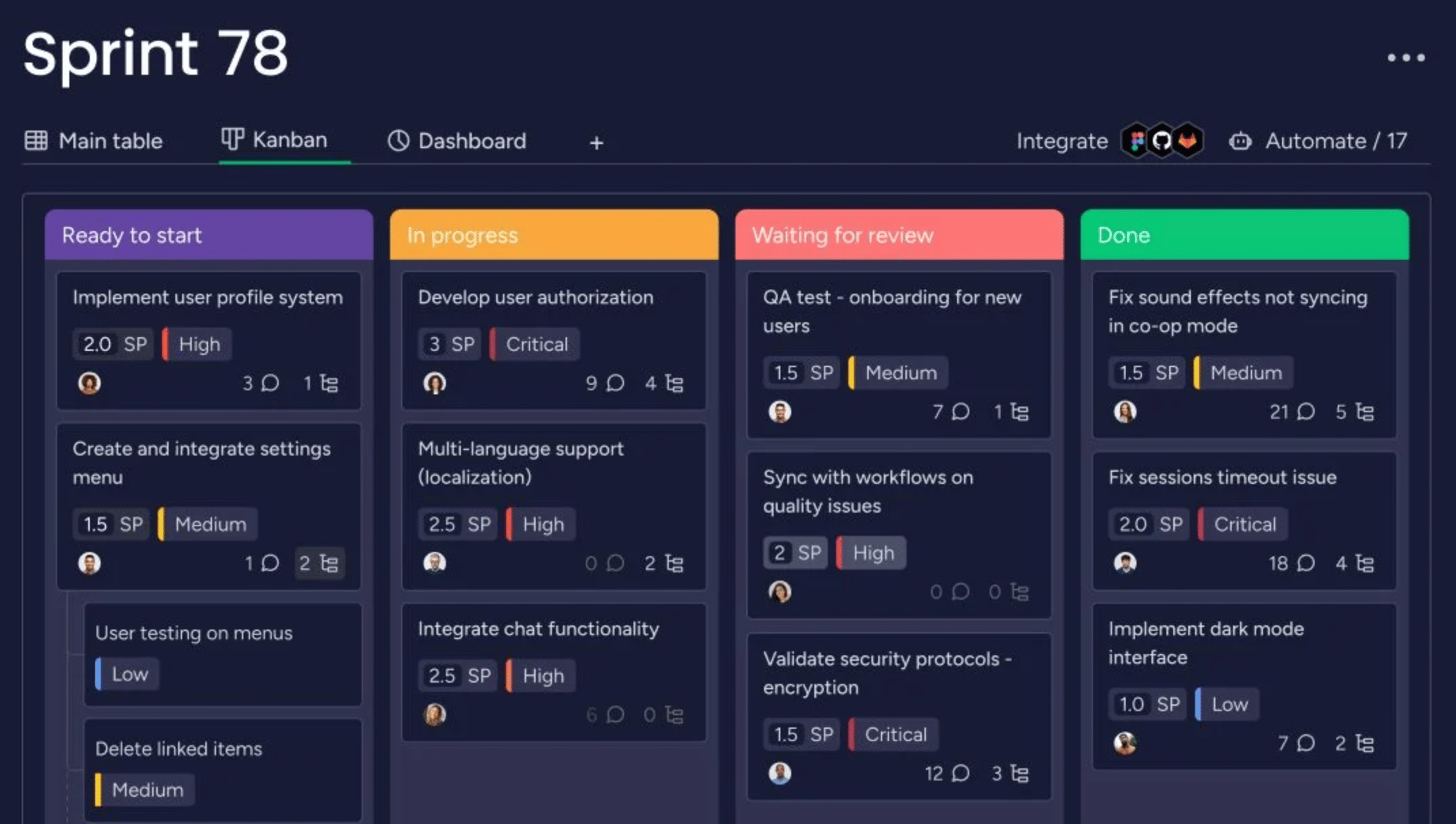
monday dev, monday.com’s Agile-focused platform, is a strong option for software development teams because it blends sprint planning, backlog tracking, and real-time reporting in one place that aligns with common Agile practices. The Agile Insights tool provides velocity and burndown charts to track sprint performance. It also supports sprint automations and integrates with developer systems such as GitHub to bring code changes into the planning workflow.
Visit mondayJira
ClickUp
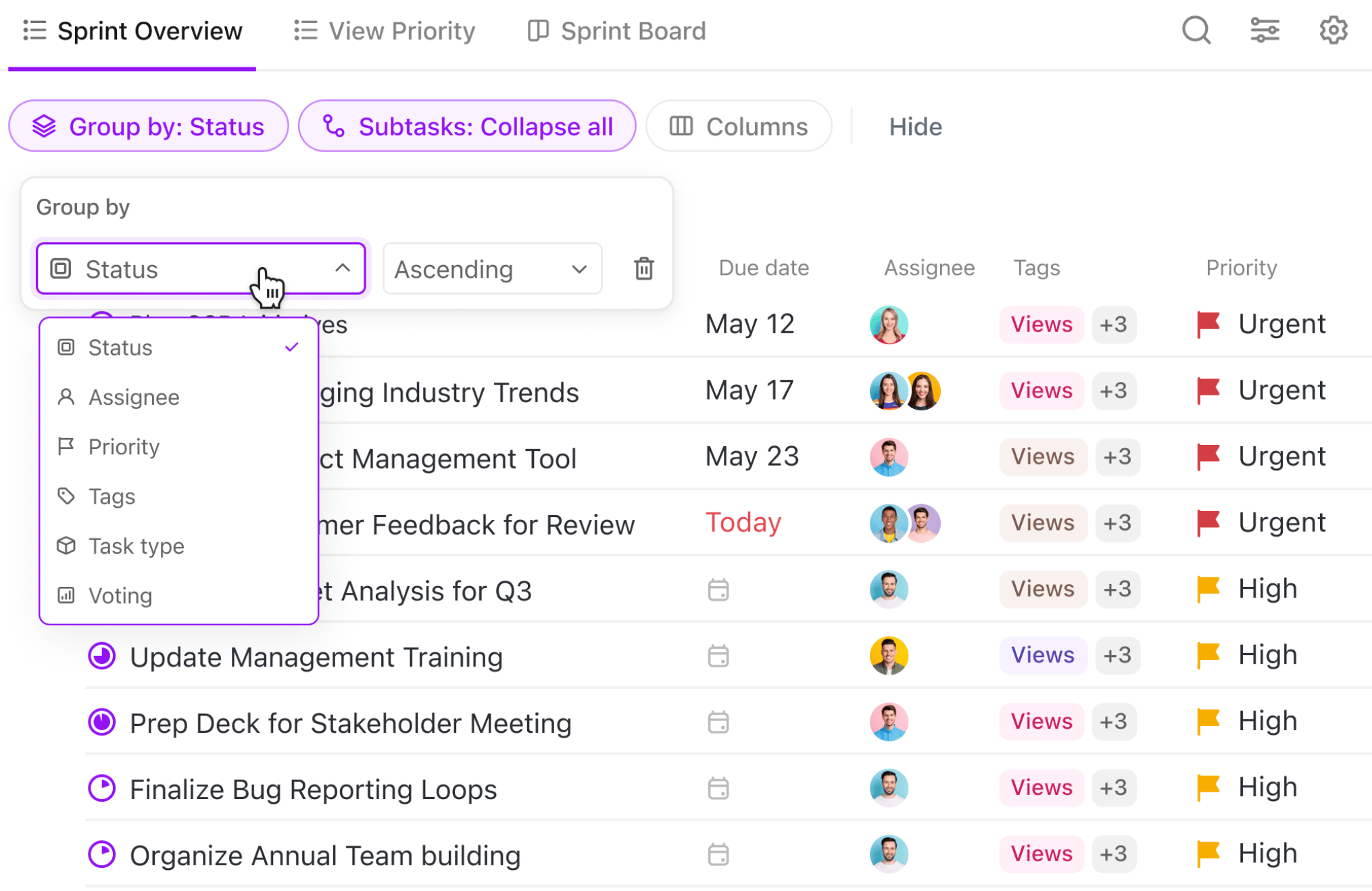
ClickUp provides a no-code project management platform tailored for engineering teams, supporting bug tracking, sprint management, and product launches. Teams can monitor sprint progress in real time using custom widgets and a flexible story points system. Sprint dashboards display burndown charts, velocity tracking, and flow diagrams to measure progress and remaining work. Integrations with GitHub and Bitbucket link commits and pull requests to ClickUp tasks, while sprint automation handles task rollover and performance tracking.
Visit ClickUpWrike
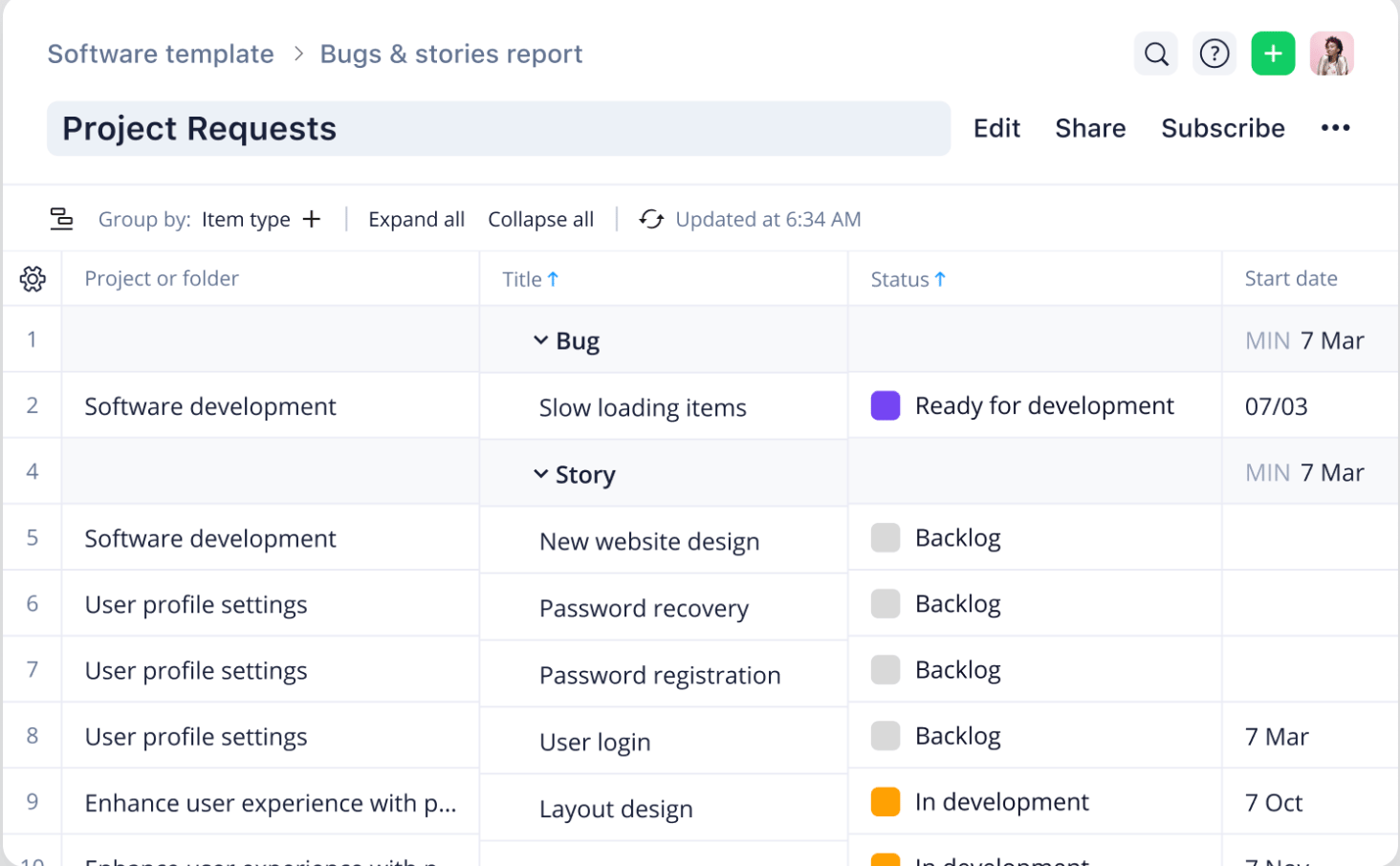
Wrike is well-suited for agile software development because it lets teams tailor workflows and project structures to match their preferred framework, from Scrum to Kanban or hybrid models. Its dynamic request forms simplify backlog management by capturing only the information needed for each task, automatically creating tickets, and triggering workflows. Its AI engine supports sprint planning with automated task descriptions and suggestions that highlight priorities and blockers. Real-time dashboards display sprint progress and project health, while integrations with tools like GitHub, Jira, and Slack connect teams to their existing tech stack.
Visit WrikeBest practices for Agile software development
Beyond selecting the right Agile tools, successful software development requires mastering specific practices that guide teams towards delivering value on each sprint.
- Prioritize the backlog continuously: Review and reorder backlog items based on business value and feedback. This ensures the team always works on what matters most.
- Define clear acceptance criteria: Write specific conditions that determine when a task is complete. Clear expectations reduce rework and prevent misunderstandings.
- Commit to realistic sprint goals: Select work the team can complete within the sprint timeframe. A focused goal improves predictability and team accountability.
- Demonstrate working software frequently: Present completed features at the end of each sprint. Regular reviews validate progress and gather early feedback.
- Reflect and improve after every sprint: Identify what slowed the team down and decide what to change next time. Continuous adjustment strengthens delivery over time.
FAQs
What is the difference between Scrum and Agile?
Agile is a set of principles that guides teams to build software in small increments while adapting to change. Scrum is a framework that applies Agile through timeboxed work cycles and collaborative meetings such as sprint planning and reviews.
Is Agile better than Waterfall?
Agile works better when requirements change, and teams need regular input from stakeholders. Waterfall fits projects with fixed scope and strict documentation requirements. The right choice depends on how stable the project requirements are and how often changes are expected.
How long is an Agile sprint?
An Agile sprint typically lasts one to four weeks, with two weeks being the most common duration for balancing delivery speed and team focus.