






















Key takeaways
- The five project management phases cover the entire project life cycle: Initiation, planning, execution, monitoring and controlling, and closure guide activities from authorization through final handover.
- Project management phases may overlap or repeat depending on the methodology: Planning and monitoring activities can recur during execution, particularly in Agile and hybrid projects.
- Advancing to the next project phase depends on defined completion criteria: Project managers verify deliverables, assess outstanding risks, and secure required stakeholder approvals before proceeding.
- What are the five phases of project management?
- Phase 1: Project Initiation
- Phase 2: Project planning
- Phase 3: Project execution
- Phase 4: Project monitoring & controlling
- Phase 5: Project closure
- How do the project management phases work in Agile & Hybrid projects?
- How to know when a project is ready to move to the next phase
- How project management software can help
- FAQs
What are the five phases of project management?
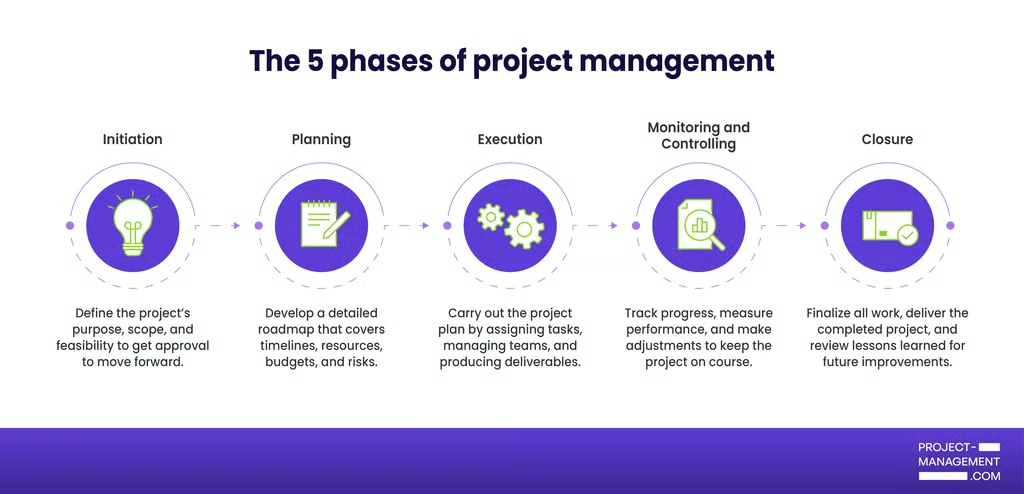
The five phases of project management are initiation, planning, execution, monitoring and controlling, and closure. These stages provide a framework for evaluating project viability, preparing the work, producing deliverables, tracking performance, and confirming completion. Each serves a specific purpose, although activities may overlap or repeat as project requirements change.
The table below summarizes each phase, its expected outputs and the conditions used to determine whether the project is ready to proceed.
| Phase | Primary purpose | Typical output | Completion indicator |
|---|---|---|---|
| 1. Initiation | Establish project viability and secure authorization | Project charter | Sponsor authorizes the project |
| 2. Planning | Define the work, schedule, budget, and resources | Approved project management plan | Required plans and baselines receive approval |
| 3. Execution | Coordinate work and produce project deliverables | Completed work products | Deliverables meet agreed acceptance criteria |
| 4. Monitoring and controlling | Evaluate performance and address deviations | Performance reports, forecasts and change decisions | Continues throughout the project as needed |
| 5. Closure | Confirm acceptance and transfer responsibilities | Final acceptance and handover records | Closure requirements are satisfied |
PMI categorizes initiation, planning, execution, monitoring and controlling, and closure as process groups. These activities may occur within different project life cycle phases, depending on the delivery approach.
Phase 1: Project Initiation
Project initiation determines whether a proposed project is worth pursuing, what it should achieve, and who can authorize it. During this phase, the project manager and stakeholders assess feasibility, define the preliminary scope, and establish success criteria.
The assessment focuses on whether the expected business value justifies the investment. Key activities include:
- Assessing feasibility: Evaluate technical requirements, estimated costs, and resource availability.
- Defining preliminary scope: Identify the project's objectives, expected outcomes, and major constraints.
- Establishing success criteria: Determine how stakeholders will evaluate whether the project achieves its intended results.
For example, a company may postpone a software implementation if the expected savings are substantial, but the required technical expertise is unavailable.
Key activities & deliverables in project initiation
Three documents typically inform the decision to proceed:
| Deliverable | Purpose |
|---|---|
| Business case | Justifies the investment based on expected benefits, costs and business needs |
| Project charter | Authorizes the project and establishes its objectives, preliminary scope, and project manager's authority |
| Stakeholder register | Identifies affected individuals or groups and their interests or influence |
When is the initiation phase complete?
Initiation concludes when the sponsor or designated decision-maker evaluates the proposal and determines whether it should proceed.
Four outcomes are possible:
- Approve: Authorize the project to proceed.
- Approve conditionally: Require specific issues to be resolved before further commitments.
- Defer: Postpone the project until funding, resources, or priorities change.
- Reject: Decline the proposal when costs, risks, or feasibility concerns outweigh expected benefits.
A successful initiation process can result in a rejected proposal. The purpose is to reach an informed investment decision before committing substantial resources.
Phase 2: Project planning
Project planning turns approved objectives into an actionable plan for completing the work. The project manager defines the scope, develops the schedule, estimates costs, and identifies the resources needed to deliver the project.
Key planning activities include:
- Defining scope: Identify project deliverables and divide the work into manageable components using a work breakdown structure (WBS).
- Developing the schedule: Estimate task durations, identify dependencies, and establish milestones.
- Planning resources: Determine staffing requirements, availability, and estimated costs.
- Assessing risks: Identify potential threats and develop response plans.
Key activities & deliverables in project planning
The main output is the project management plan, which documents how the team will execute, monitor, and manage project work.
| Deliverable | Purpose |
|---|---|
| Scope baseline | Defines approved deliverables and the work required |
| Schedule baseline | Establishes approved dates for measuring progress |
| Cost baseline | Sets the approved budget for evaluating spending |
| Resource management plan | Identifies staffing needs and resource allocation |
| Risk register | Records identified risks and planned responses |
The three baselines provide reference points for comparing actual performance against approved commitments. Changes to these baselines generally require authorization through the project's change management process.
When is the project plan ready for execution?
Before execution begins, verify these four conditions:
- Scope: Are deliverables and requirements sufficiently defined?
- Dependencies: Are critical task relationships and resource constraints understood?
- Approvals: Have stakeholders authorized the required budget and schedule?
- Acceptance: Are deliverable acceptance criteria and change procedures established?
Approved plans can still contain unresolved assumptions that threaten delivery. Before committing to execution dates, document critical assumptions and assess their potential effects. Resolve those that could materially affect the schedule or budget, and establish contingency plans for remaining uncertainties.
Phase 3: Project execution
Project execution is when teams carry out planned activities and produce project deliverables. Team members complete assigned work, while the project manager coordinates resources, resolves dependencies and addresses issues that could affect delivery.
Key activities include:
- Coordinating work: Assign responsibilities and manage workloads to keep dependent tasks on schedule.
- Managing quality: Verify that work follows agreed standards and quality requirements.
- Resolving issues: Address technical problems or resource shortages that affect progress.
- Communicating changes: Inform stakeholders about approved changes and their impact on project work.
Key activities & deliverables in project execution
Execution produces the work products defined in the project plan. Common outputs include:
| Deliverable | Purpose |
|---|---|
| Completed work products | Produce the outputs specified in the project scope |
| Quality records | Document inspections, tests, and quality results |
| Issue log | Track problems, assigned owners, and resolution status |
| Change requests | Propose modifications to approved project commitments |
The exact deliverables depend on the project. Completed work may still require verification or stakeholder acceptance before it can be considered fully accepted.
What happens when a deliverable fails acceptance tests?
A failed acceptance test requires the project manager to determine whether the team should correct the work or request a change to approved requirements.
For example, if a software feature fails security testing, the response depends on the cause:
- Corrective work: Fix the vulnerability if the existing requirements already cover the security issue.
- Schedule revision: Update the completion forecast if remediation requires additional time.
- Change request: Seek approval if the proposed solution modifies agreed requirements or controlled commitments.
A completed task does not necessarily mean an accepted deliverable. A feature may be marked complete in the project schedule but still fail security testing. Project managers should report task completion and deliverable acceptance separately to give stakeholders an accurate view of project progress.
Phase 4: Project monitoring & controlling
Project monitoring and controlling involves measuring project performance and addressing deviations from the approved plan. These activities occur throughout the project, particularly during execution.
The two processes serve different purposes:
- Monitoring: Tracks actual progress, costs, and deliverable quality against project requirements and approved baselines.
- Controlling: Determines corrective actions, addresses performance issues, and manages changes to project commitments.
For example, if a critical task falls two weeks behind schedule, the project manager assesses its impact and determines whether to reassign resources, revise the forecast, or request a schedule change.
Which project metrics should you track?
Project managers should prioritize metrics that help identify performance issues and guide decisions.
| Metric | What it helps evaluate |
|---|---|
| Schedule variance | Whether earned progress is ahead of or behind schedule |
| Cost variance | Whether earned value differs from actual costs |
| Forecast completion date | Whether the project is likely to meet its deadline |
| Open critical risks | Which threats require immediate attention |
| Defect or acceptance status | Whether deliverables meet agreed requirements |
In earned value management, schedule variance compares earned value against planned value, while cost variance compares earned value against actual cost. Teams can also track milestone dates and spending directly if they do not use earned value management.
What should happen when a project deviates from the plan?
When performance falls outside expectations, project managers should follow four steps:
- Identify the variance: Determine which commitments are affected.
- Find the cause: Investigate inaccurate estimates, resource shortages, or unresolved dependencies.
- Assess the impact: Forecast effects on remaining work, costs, and deadlines.
- Take action: Resolve issues within the project manager's authority or escalate changes requiring approval.
A high task completion rate does not always indicate that a project is on schedule. Project managers should evaluate task completion alongside milestone progress and forecast dates to give stakeholders a more accurate picture of project status.
Phase 5: Project closure
Project closure confirms that project deliverables meet agreed requirements, have received formal acceptance, and are ready for handover. The project manager verifies completed work, settles contractual obligations, and reconciles final expenses where applicable.
Key activities & deliverables in project closure
Common closure deliverables include:
| Deliverable | Purpose |
|---|---|
| Formal acceptance | Confirms stakeholder approval of completed deliverables |
| Handover documentation | Transfers operating instructions and support responsibilities |
| Final project report | Summarizes performance, costs, and project outcomes |
| Lessons learned register | Records findings that can improve future project planning |
Before closing the project, verify that outstanding obligations have been resolved or assigned to an authorized owner.
What happens after project closure?
Project closure and benefits realization can occur at different times. A project may meet its completion criteria even when the expected business benefits take months to materialize.
After handover, responsibilities typically shift to:
- Operational owners: Maintain the deliverable and provide ongoing support.
- Business owners: Monitor adoption and measure expected business outcomes.
- Project sponsors: Review whether the investment delivers the anticipated benefits.
A project handover should identify who owns each expected benefit and how it will be measured. This establishes accountability for business outcomes after the project team has completed its work.
How do the project management phases work in Agile & Hybrid projects?
Agile and hybrid projects use the same five project management process groups, but the timing and frequency of activities differ. Predictive projects typically establish extensive plans upfront, while Agile teams revisit planning and execution as requirements evolve. Hybrid projects combine these approaches based on the work involved.
The table below shows how each approach applies the five process groups.
| Process group | Predictive (Waterfall) | Agile (Adaptive) | Hybrid |
|---|---|---|---|
| Initiation | Authorizes the project and defines objectives | Establishes project goals and initial priorities | Defines business objectives and major constraints |
| Planning | Develops detailed plans upfront | Refines plans through iterations | Combines overall milestones with iterative planning |
| Execution | Delivers work according to planned stages | Produces work through iterations or continuous flow | Uses different delivery methods for different components |
| Monitoring and controlling | Measures performance against approved baselines | Reviews progress through feedback and delivery metrics | Combines milestone tracking with iterative reviews |
| Closure | Confirms final acceptance and handover | Confirms project-level completion and transfers ownership | Verifies acceptance across all project components |
Do Agile projects follow the five phases of project management?
Yes. Agile projects perform initiation, planning, execution, monitoring and controlling, and closure activities, although these processes may repeat throughout delivery.
Three activities are worth distinguishing:
- Sprint review: Examines completed work and gathers stakeholder feedback.
- Sprint retrospective: Evaluates how the team worked and identifies improvements.
- Project closure: Confirms overall completion, acceptance and handover.
How to know when a project is ready to move to the next phase
A project is ready to advance when required deliverables meet acceptance criteria, critical risks are addressed, and authorized stakeholders approve the next phase. Project managers assess these conditions through phase gates, or checkpoints used to determine whether work can proceed.
Review requirements depend on the project. Regulated or contract-driven projects may require documented approvals and compliance evidence, while smaller projects may rely on brief stakeholder reviews.
What should be reviewed at a phase gate?
Before advancing, project managers should check five areas:
- Deliverables: Have the required outputs met acceptance criteria?
- Risks: Are unresolved issues and critical risks adequately addressed?
- Resources: Are the budget and personnel available for the next phase?
- Business value: Do the expected benefits still justify the remaining investment?
- Approvals: Has the sponsor or designated decision-maker authorized continuation?
What if a project fails a phase review?
A phase review typically leads to one of four decisions:
| Decision | Next step |
|---|---|
| Proceed | Authorize the next phase |
| Proceed with conditions | Continue once specified requirements are met or under agreed restrictions |
| Rework | Correct deficiencies and repeat the review |
| Stop | Suspend or terminate the project |
Depending on the findings, teams may need to revisit planning activities, revise estimates, or complete additional testing.
How project management software can help
Project management software helps teams plan work, coordinate activities, and monitor progress throughout the project life cycle. It also keeps project information accessible as responsibilities and priorities change.
Centralizes project information
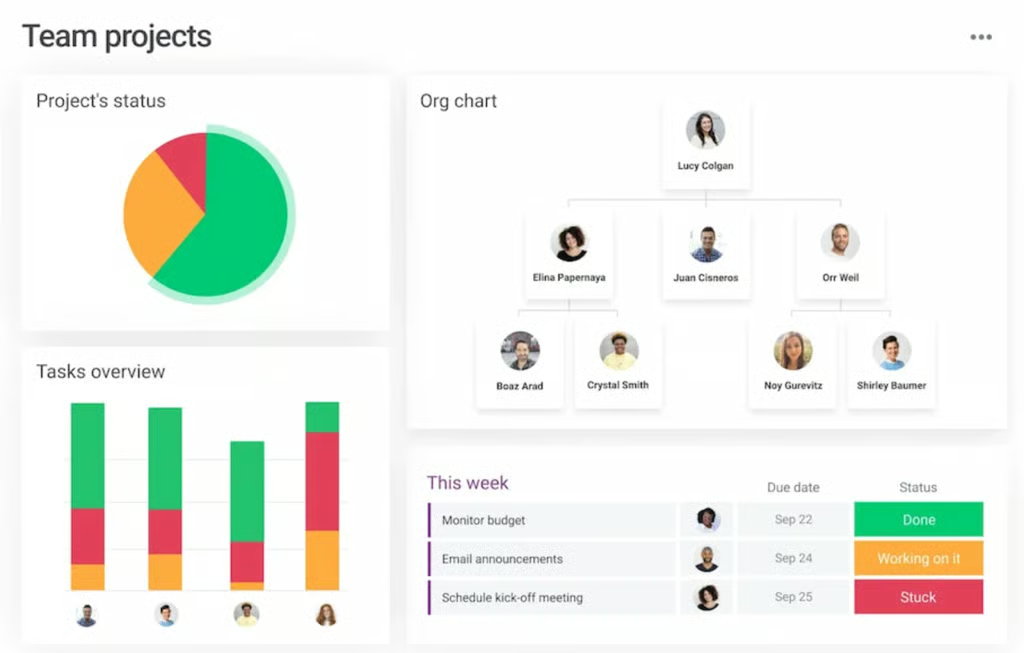
Project management tools keep tasks, deadlines, and milestones in a shared workspace. monday.com provides customizable project views and dashboards that help managers track task status and overall progress across projects.
Improves team collaboration
Built-in communication tools connect discussions to project tasks. ClickUp is one of the few AI project management software that lets teams communicate within the workspace, create tasks from conversations, and link existing tasks to messages for added context.

Supports resource & time management
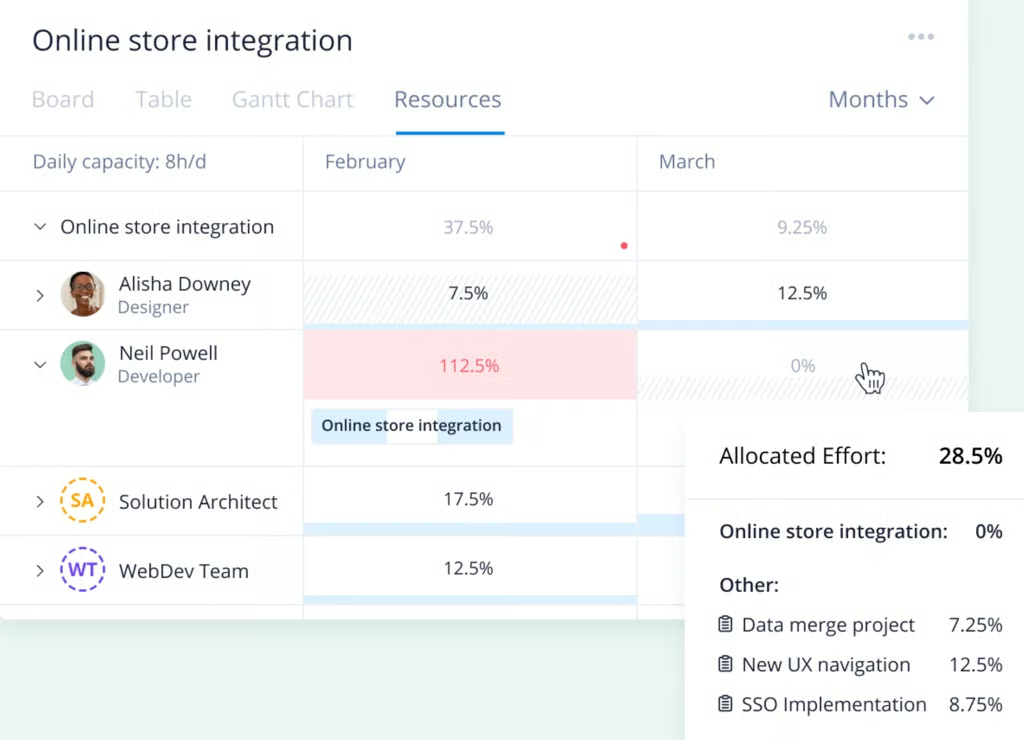
Resource management features help managers monitor workloads and identify capacity constraints. Wrike provides workload views that show team assignments and availability, which can inform resource allocation decisions.
FAQs
What are the five phases of project management?
The five phases are initiation, planning, execution, monitoring and controlling, and closure. Initiation authorizes the project, while planning defines how work will proceed. Execution produces deliverables, monitoring and controlling evaluates performance, and closure confirms acceptance and completes the project handover.
Is monitoring and controlling a separate project phase?
Monitoring and controlling is one of PMI's five project management process groups, although it is often presented as a separate phase in simplified models. Its activities occur throughout the project, particularly during execution, to assess performance and address deviations from approved plans.
Can a project return to an earlier phase?
Yes. Projects may revisit earlier activities when requirements change, unexpected risks emerge, or deliverables fail acceptance reviews. For example, a major scope change may require the team to revise estimates and schedules before continuing execution. The extent of replanning depends on the change's impact.