























KEY TAKEAWAYS
In project management, poor outcomes are most often traced back to how a project began. That is why the project management initiation phase is worth getting right, as it is the first step in establishing the scope or “starting blocks” of the project life cycle. If you are new to project management, this guide will help you understand what this phase involves and what you need to prepare.
| Phase | Overview |
| 1. Initiation | Defines the project’s purpose, scope, and stakeholders; determines if the project is feasible and worth pursuing. |
| 2. Planning | Outlines the roadmap, including timeline, resources, budget, risks, and deliverables. |
| 3. Execution | The team completes the work and produces deliverables based on the project plan. |
| 4. Monitoring & Control | Tracks progress, manages changes, and ensures the project stays on scope, time, and budget. |
| 5. Closure | Finalizes deliverables, obtains approvals, and documents lessons learned. |
- What is project initiation?
- Why the project initiation phase matters
- Project initiation vs. project planning: What’s the difference?
- Step-by-step process for the project initiation phase
- Sample project initiation document
- Roles & responsibilities during project initiation
- Common pitfalls in the initiation phase (+tips)
- Next step: The planning phase
- FAQs
What is project initiation?
The PMBOK® 8th Edition defines project initiation as the set of activities that establish a project’s purpose, align it with organizational strategy, and secure authorization to begin.
It centers on defining the project’s high-level intent, identifying key stakeholders, and confirming that the project delivers meaningful value. Think of it as getting the green light. Before any planning or execution begins, the organization needs to agree that the project is worth pursuing.
Initiation is not a one-time gate but part of a continuous alignment process, especially in adaptive environments where priorities may evolve.
Why the project initiation phase matters
The project initiation phase ensures important decisions are made before work begins, the right people are involved, and the project has an agreed-upon direction.
Here are the key benefits of completing the initiation phase properly:
- Clear project purpose: Everyone on the team understands what the project is trying to achieve and why it matters.
- Stakeholder alignment: Key stakeholders are identified and engaged early to agree on the project’s goals, expected value (ROI), and success criteria, reducing the risk of misalignment and conflicting expectations later.
- Informed decision-making: Leadership can evaluate whether the project is feasible and worth the investment before committing resources.
- Defined boundaries: The scope of the project is established, helping prevent scope creep down the line.
- Stronger project foundation: Every phase that follows, from planning to execution, is built on a solid and agreed-upon starting point.
Despite these benefits, many organizations are skipping this step. According to Wellingtone’s The State of Project Management, 47% of organizations are unlikely to create a scoping document, significantly increasing the risk of project failure from the start.
Project initiation vs. project planning: What’s the difference?
Initiation is about defining whether the project should happen and securing approval to move forward. Planning is about figuring out how it will happen, covering timelines, budgets, tasks, and resources.
| Initiation | Planning | |
| Purpose | Define and approve the project | Determine how the project will be executed |
| Key question | Should we do this project? | How will we do this project? |
| Main activities | Identifying stakeholders, defining scope, creating the project charter | Setting timelines, assigning tasks, allocating the budget |
| Key documents | Project charter, business case, feasibility study | Project plan, risk register, work breakdown structure |
| Persons involved | Project sponsor, project manager, key stakeholders | Project manager, project team |
For example, during initiation, a project manager might be answering questions like: What problem are we solving? Who are the key stakeholders? Is this project feasible? During planning, those questions shift to: Who is responsible for each task? What is the budget? When is the deadline? Initiation sets the direction, while planning builds the roadmap to get there.
Step-by-step process for the project initiation phase
The project initiation phase involves building the business case for the project, assessing its feasibility, identifying the stakeholders, creating the project charter, and securing formal approval. In many organizations, this process begins with a project intake form, which captures initial ideas and serves as the foundation for evaluating value and developing the business case.
Below is a step-by-step breakdown of how to move through this phase correctly.
Step 1: Draft the business case
Start by identifying the problem the project aims to solve or the opportunity the team wants to pursue. From there, document why the project is worth pursuing in a business case. This includes the expected benefits, estimated costs, initial risks, and the consequences of not doing the project at all.
Step 2: Assess feasibility
Evaluate whether the project can realistically be delivered given the organization’s current resources and constraints. A feasibility study examines the technical, financial, and operational factors, including projected ROI, payback period, and overall business viability. This step is most relevant for large, resource-intensive projects and can be skipped for smaller initiatives.
Step 3: Identify and analyze stakeholders
Identify everyone who has an interest in or will be affected by the project. Then conduct a stakeholder analysis to understand each person’s level of influence and interest. This ensures each stakeholder receives the right level of communication for the duration of the project.
Step 4: Develop the project charter
Consolidate everything established in the previous steps into a project charter. This document formally defines the project scope, objectives, stakeholders, high-level milestones, and initial risks. It also gives the project manager the official authority to begin work.
Step 5: Secure approval and formal authorization
Present the project charter to the project sponsor for sign-off. Once approved, the project is formally authorized to move forward. This go/no-go decision marks the official end of the initiation phase and the transition into planning.

For example, monday work management offers pre-built templates for project charter and stakeholder registers. Interactive elements such as dashboards, color-coded columns, and custom fields make organizing and collaborating on initiation documents easier for the entire team.
Visit monday.comSample project initiation document
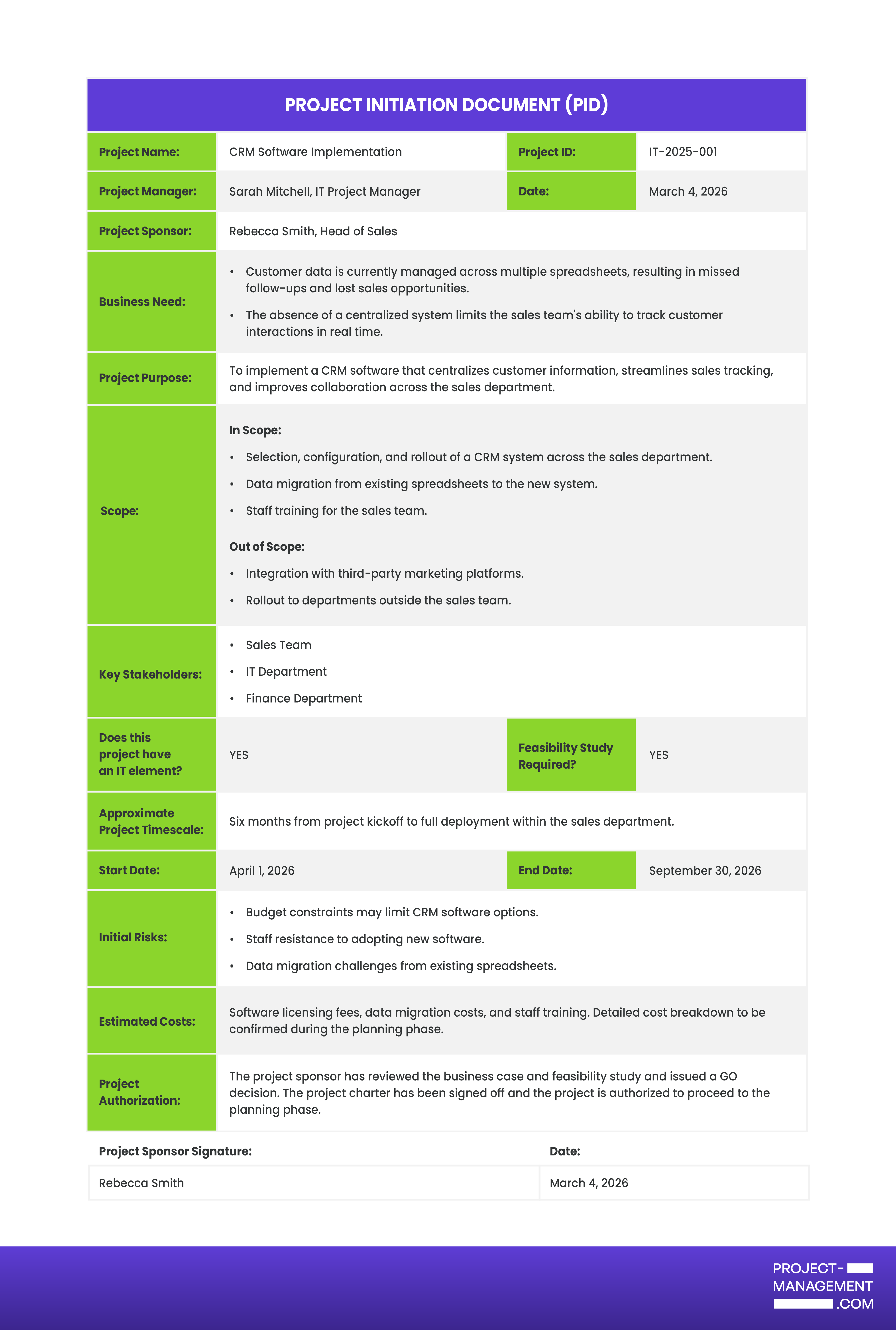
A project initiation document (PID) consolidates all key information about a project before work begins. To give you a clearer picture of what it looks like, below is a sample PID for a CRM software implementation project covering fields such as project purpose, scope, stakeholders, risks, and formal authorization.
If you are ready to get started, you can also download our free PID template below and fill it in for your own project.
Roles & responsibilities during project initiation
The project sponsor, project manager, and stakeholders are the three primary roles involved during the project initiation phase. Each plays a distinct part in ensuring the project is defined, approved, and set up for success.
| Project sponsor | Project manager | Project stakeholders | |
| Who they are | A senior leader or executive within the organization | The person responsible for leading the project | Individuals or groups with a significant interest in the project |
| Primary role | Provides executive authority and final approval | Leads and coordinates the initiation process | Provides input and validates project direction |
| Key responsibilities | Approves the business case and signs off on the project charter | Develops initiation documents and identifies stakeholders | Identifies concerns and confirms the project addresses the right problem |
| Decision authority | Highest — gives the final go/no-go decision | Operational — manages the initiation process | Advisory — influences but does not make final decisions |
Common pitfalls in the initiation phase (+tips)
A poorly defined scope, missing stakeholder engagement, and an unsigned project charter are some of the most common mistakes that could derail a project during the initiation phase. Below are four of the most frequent pitfalls and how you can prevent them.
1. Skipping the business case
Some teams are eager to jump straight into the work without taking the time to justify the project. Without a business case, there is no documented reason for the project to exist, making it difficult to secure resources or defend decisions down the line. Always document the project’s purpose and expected value before seeking approval, no matter how straightforward the project seems.
2. Poorly defined scope
One of the most damaging mistakes in initiation is starting a project without established boundaries. When the scope is vague, teams end up taking on work that was never part of the original agreement, leading to delays, budget overruns, and burnout. Take the time to define what is in scope and, just as importantly, what is not.
3. Ignoring key stakeholders
Failing to identify and engage the right people is a mistake that almost always catches up with a project later. A stakeholder who is left out during initiation may raise concerns mid-project that could have been addressed from the start. Conduct a thorough stakeholder analysis and ensure all relevant parties are identified and engaged before moving into planning.
4. Moving into planning without a signed project charter
The project charter is the document that formally authorizes the project. Skipping sign-off and moving straight into planning means the project lacks official approval, which can lead to confusion over authority, scope, and priorities later. Always ensure the project sponsor reviews and signs the project charter before closing the initiation phase.
Next step: The planning phase
After completing the project initiation phase, the next step is project planning. In this stage, we will explore the steps needed to achieve project goals; establish budgets, project timeline, and milestones; and source materials and necessary documents. This includes how to calculate and predict risk, put change processes into place, and outline communication protocols.
FAQs
What documents are produced in the project initiation phase?
The main documents produced during initiation are the project charter, business case, feasibility study, stakeholder register, and initial scope statement. These documents collectively define the project, justify its existence, and secure the approval to move forward.
What is the difference between a project charter and a project initiation document?
A project charter formally authorizes the project and is typically a shorter, high-level document. A project initiation document (PID) is more detailed and consolidates all initiation information in one place. Think of the charter as the approval and the PID as the full story behind it.
How long does the project initiation phase take?
It depends on the size and complexity of the project. A small internal project may take a few days, while a large organizational initiative could take several weeks. The priority is thoroughness over speed. Rushing through initiation to save time often creates bigger problems later.