





















In 2026, project professionals are shifting toward full AI integration, and economic pressure is forcing organizations to shorten delivery cycles and adjust project spend. To help you navigate the changing PM landscape in 2026 and beyond, this guide breaks down the project management trends shaping AI adoption, workforce shifts, and the rise of hybrid methodologies.
Expert contributors


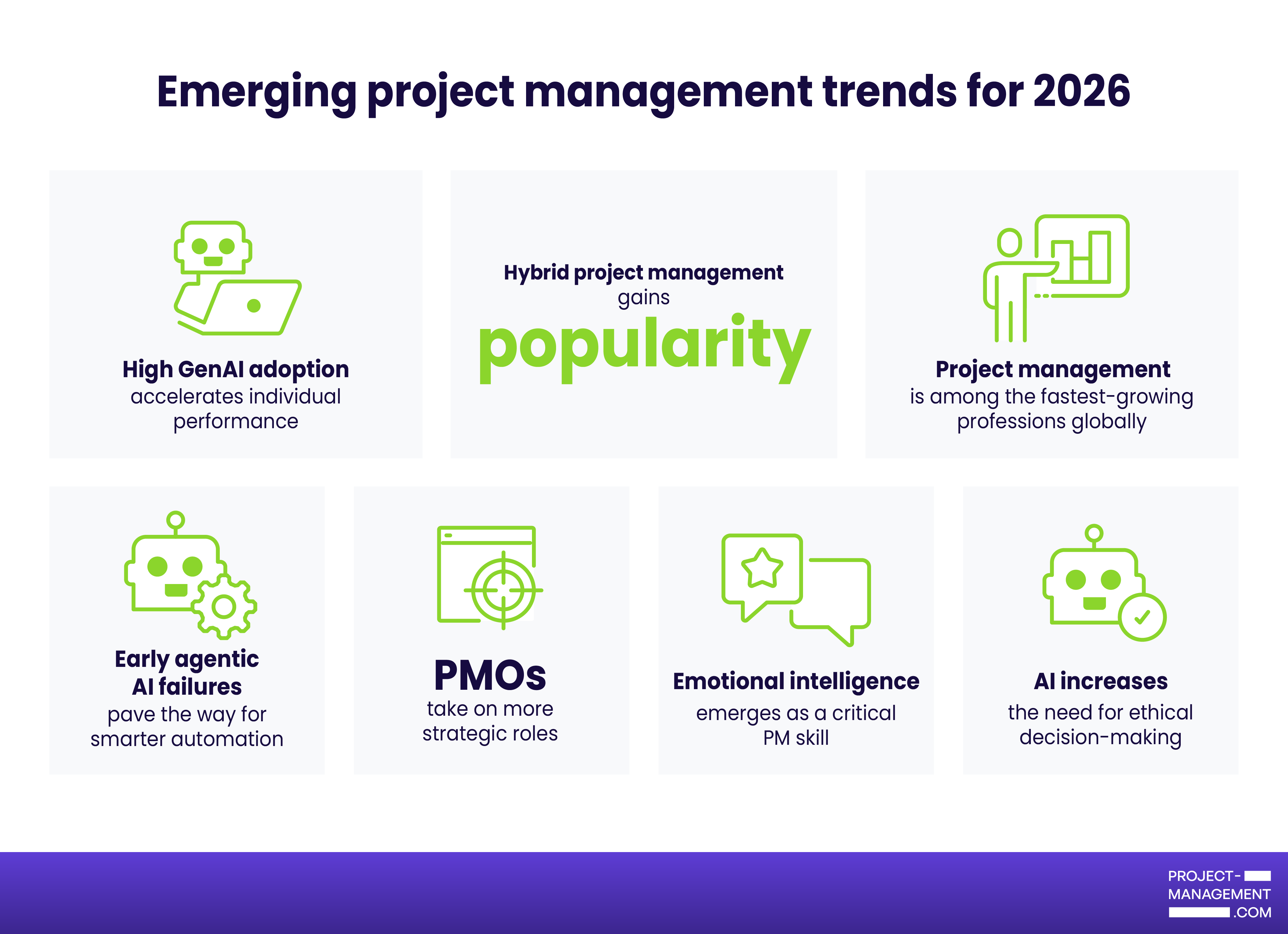
- 1. High GenAI adoption accelerates individual performance
- 2. Early agentic AI failures pave the way for smarter automation
- 3. Hybrid project management gains popularity
- 4. PMOs take on more strategic roles
- 5. Project management is among the fastest-growing professions globally
- 6. Emotional intelligence emerges as a critical PM skill
- What these trends mean for project managers in 2026
- FAQs
1. High GenAI adoption accelerates individual performance
According to PMI’s report on GenAI adoption, project professionals who use GenAI in more than half of their projects report positive impacts across quality management (91%), scope management (87%), cost management (86%), and schedule management (85%).
Beyond efficiency, GenAI is also helping project managers strengthen essential skills like collaboration and creativity, making it a key driver of innovation and performance in project management.
Expert forecast: “AI and its use are dominating all professional fields, and project management is not exempt. I think it will be interesting to see how industry tools begin to build and add AI features. For example, AI can help estimate resource needs and task durations and analyze, integrate, and present project data from multiple sources to provide a holistic view of project performance.” – Alan Zucker, PMP |
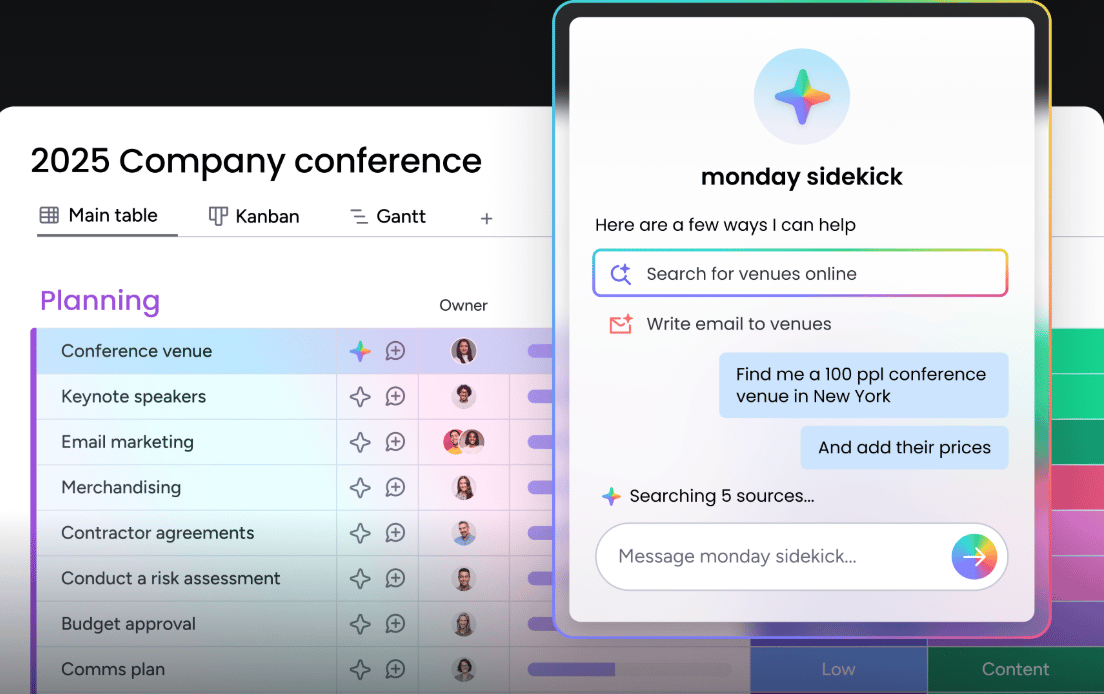
Those who are high adopters of GenAI also report a 93% increase in productivity through tools that automate routine tasks. For example, monday work management’s AI sidekick can handle a wide range of tasks, such as researching the web, analyzing board data, and managing project boards. It serves as an always-on assistant that understands your full project context and completes tasks through simple, conversational prompts.
2. Early agentic AI failures pave the way for smarter automation
According to Gartner, more than 40% of agentic AI projects will be canceled by 2027 due to high costs, unclear business value, and poor risk management.
Anushree Verma, Gartner’s Senior Director Analyst, contextualized this prediction in a press release: “Most agentic AI projects right now are early-stage experiments or proofs of concept that are mostly driven by hype and are often misapplied.” This trend emphasizes that organizations must move past the excitement and apply agentic AI where it creates actual value.
Despite these early setbacks, agentic AI has been making progress in automation and decision-making. Gartner predicts that by 2028, at least 15% of operational decisions will be made autonomously, up from 0% in 2024. Agentic AI will equip teams with advanced tools to improve resource efficiency, handle complex workflows, and drive innovation beyond what traditional automation can achieve.
3. Hybrid project management gains popularity
PMI’s Pulse of the Profession 2024 report revealed 73% of project professionals anticipate greater use of hybrid approaches over the next five years. This growth is driven by successful hybrid experiences and increasing project complexity.
Expert forecast: “The decline in the number of project teams using Agile will continue, as will the long-term decline in predictive methodologies. By default, more teams will report using hybrid. Along with this shift, I expect we will eventually see associated hybrid project management frameworks and training.” – Alan Zucker, PMP |
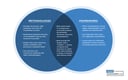
A hybrid approach typically involves structuring high-level project phases with traditional milestone planning and fixed deadlines, while embedding agile sprints within those phases for iterative development.
For example, a software implementation project might have Waterfall-style stages for compliance reviews and client approvals, but use two-week sprints for design and development work. This requires tools that can simultaneously track long-term dependencies and critical paths while supporting sprint planning, backlog management, and rapid iteration.
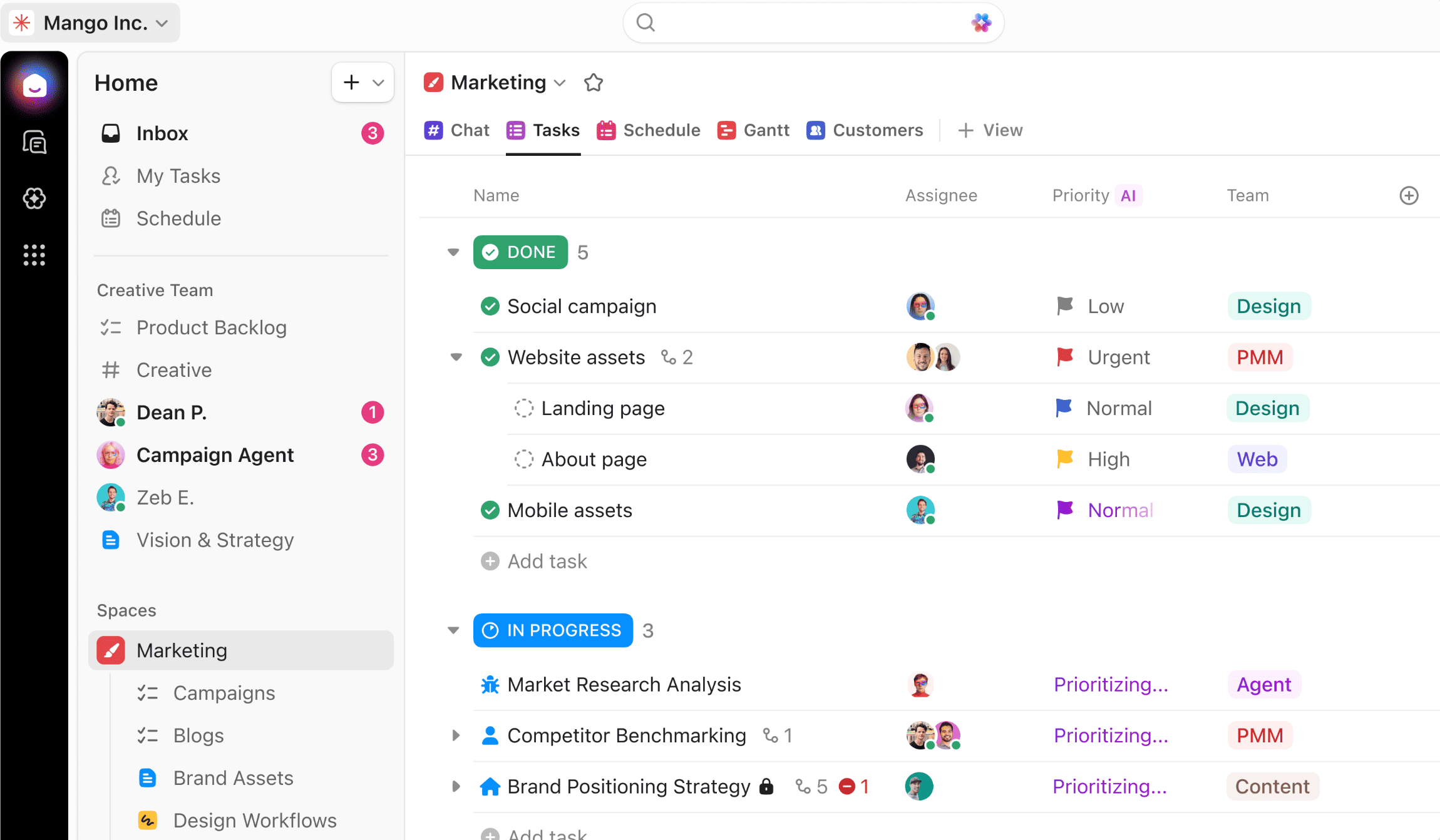
ClickUp provides exactly this capability by combining both methodologies in one platform. Project managers can monitor timelines through Gantt charts and milestone progress trackers while agile teams execute sprints with story points and burnup charts. Different team members can view and interact with the same tasks using the methodology that suits their role—whether that’s a timeline view for phase dependencies or a sprint board for development tasks.
4. PMOs take on more strategic roles
According to Wellingtone’s State of Project Management 2025, PMOs are doing more to share project management expertise with teams and helping organizations apply lessons from completed projects. This shift toward value-driven leadership is evidenced by the specific PMO activities that have shown the most growth over the last five years:
| Previous PMO responsibilities | New PMO responsibilities |
| Status reporting: Primarily focused on collecting and archiving project updates. | Business consulting: Acting as a consultant to guide the organization’s future direction. |
| Process policing: Enforcing strict adherence to document templates and methodologies. | Providing management expertise: Offering high-level guidance to improve project delivery across the organization. |
| Data archiving: Storing data from past projects for compliance. | Facilitating lessons learned: Actively using past data to drive continuous improvement. |
The report also shows that in 2017, only one-third of PMOs reported having a defined remit and objectives, but that figure had increased to 53% in 2025. PMOs are becoming more strategically embedded within organizations, with clearer mandates and broader roles in driving long-term value across projects.
5. Project management is among the fastest-growing professions globally
According to the World Economic Forum’s Future of Jobs 2025 Report, demand for project managers is growing rapidly worldwide. As industries adopt new technologies and business models shift, organizations need experienced project managers who can coordinate complex initiatives, manage cross-functional teams, and ensure strategic alignment across digital transformation efforts. Their technical understanding must be matched with strong leadership, communication, and analytical skills.
The PMI Global Project Management Talent Gap report reinforces this trend, projecting that global demand for project management talent could rise by 64% from 2025 to 2035. PMI estimates that demand for project professionals could reach 65 million by 2035, yet the available talent supply could fall short by nearly 30 million.
This widening gap creates both a challenge and an opportunity for businesses. Companies can address it through targeted upskilling and reskilling programs that build foundational project management capabilities and open career pathways for emerging professionals.
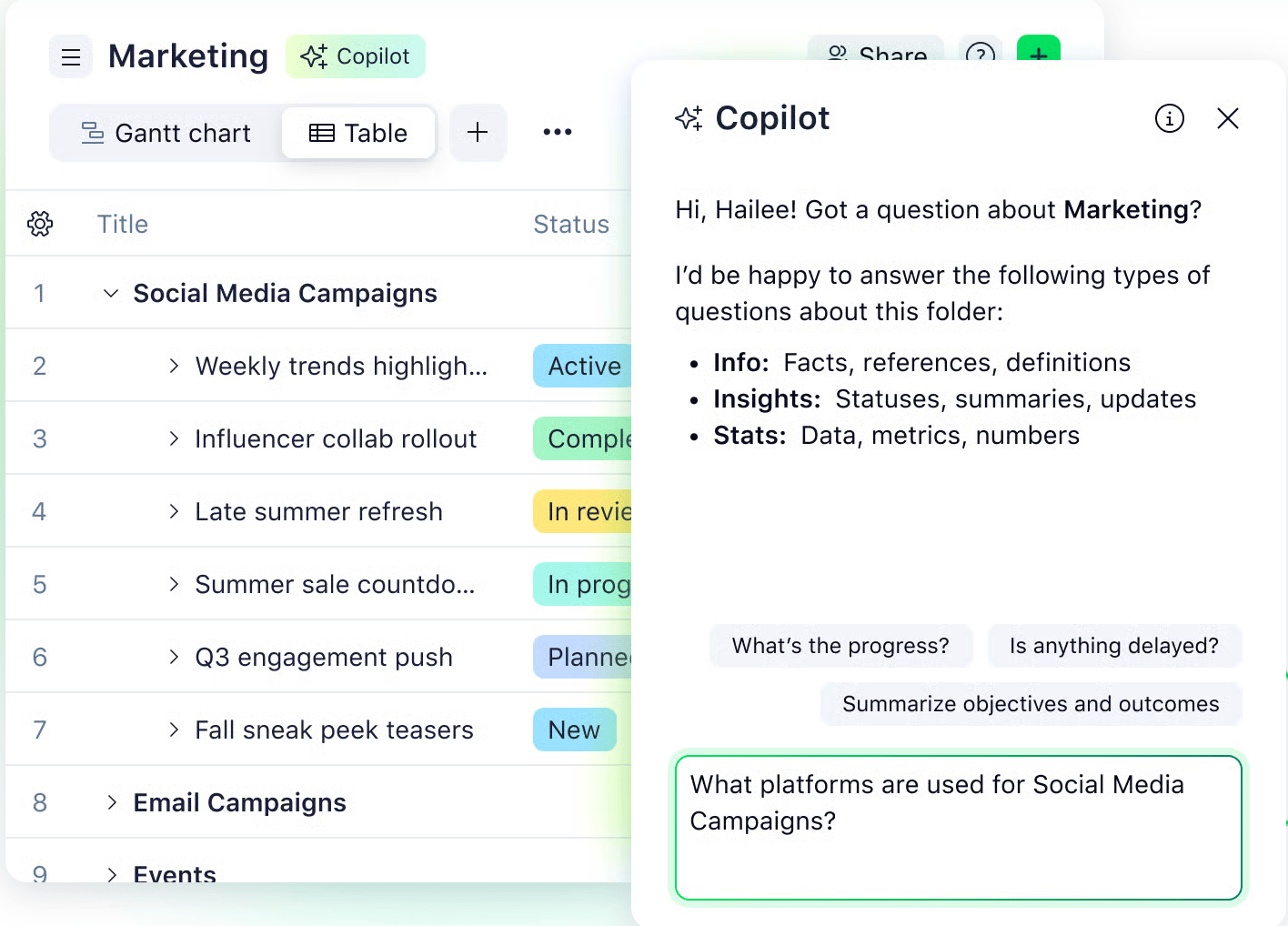
With project roles becoming more complex, you need an AI-driven platform that adapts to different project requirements and scales work efficiently. Wrike is embracing project management software trends with customizable AI agents that act as assistants to help you prioritize projects, answer queries, and identify potential risks before they escalate.
Visit Wrike6. Emotional intelligence emerges as a critical PM skill
A 2024 Capterra survey found that 85% of project managers had increased their emotional intelligence (EQ) — the ability to recognize, understand, and manage one’s own emotions and those of others — since 2022. In the U.S., 39% of project managers reported a significant increase in their EQ, compared from 26% in 2023. This reveals that project success relies not only on technical expertise but also on team relationships and effective conflict management.
Project managers who apply EQ to resolve conflict often achieve stronger collaboration and better project results. In fact, 31% of surveyed professionals said EQ positively impacts risk management. By encouraging open communication and proactive problem-solving, emotionally intelligent leaders create teams that are more engaged, resilient, and committed to project success.
Formal training can help project managers develop critical EQ skills, such as empathy and active listening. For example, Coursera’s Emotional Intelligence in Leadership course helps leaders identify their strengths and weaknesses, resolve conflicts effectively, and build stronger working relationships with their teams.
Visit Coursera7. AI increases the need for ethical decision-making
As project environments become more complex, ethical judgment is emerging as a defining skill for project managers. PMs are expected to make decisions in gray areas where efficiency and innovation often compete with data protection, fairness, and long-term risk. The stakes get even higher when AI is added to the mix, as noted in PMI’s report on GenAI adoption.
For example, a PM might recognize that using AI could enhance a workflow, but they must weigh the benefits against potential risks, such as data privacy violations. Even free GenAI tools collect user data to train their models, meaning any information shared with the tool could be accessible to other users.
Compliance requirements, particularly around AI and data handling, have intensified these ethical considerations. Project managers are now under pressure to carefully evaluate which tools are appropriate for their projects and what information can safely be shared.
To meet these demands, project managers must cultivate a strong ethical framework grounded in transparency, accountability, and respect. This means fostering open dialogue about difficult decisions and seeking diverse perspectives when trade-offs arise.
What these trends mean for project managers in 2026
The year 2026 marks a turning point where project managers must balance AI adoption with human expertise.
GenAI and automation will be crucial for optimizing workflows and assessing project risks. Hybrid models will continue to shape how teams operate, requiring managers to adapt workflows based on the project’s needs. Meanwhile, emotional intelligence and ethical leadership will become the key factors that determine team engagement and project success.
As PM roles expand amid workforce shifts, focusing on these emerging project management industry trends will allow project managers to position themselves for success. The future of project management is dynamic, and those who stay flexible and innovate will lead the way.
FAQs
What is the biggest project management trend in 2026?
The most significant trends center on deeper AI integration and broader use of Hybrid methods. This means project managers rely on AI to generate forecasts or flag risks while choosing approaches that match the project’s scope and available resources instead of applying one fixed methodology.
What is Hybrid project management?
According to PMI, Hybrid project management combines Predictive and Agile approaches to tailor processes to diverse project needs and environments. For instance, a team may use Predictive methods to define milestones and budgets during project initiation while using short, iterative cycles to release customer-facing features based on feedback or changing constraints.
Is the project manager role dying in 2026?
No, the project manager role is not dying in 2026, but it is shifting towards higher-value work. As AI and automation handle administrative work, project managers will concentrate on more strategic responsibilities such as managing stakeholder expectations, mitigating project risks, and guiding teams through complex initiatives.