






















Key takeaways
In project management, the procurement process plays a crucial role in ensuring projects have the right resources and expertise. When it comes to vendor selection, companies rely on three request documents to gather information, evaluate proposals, and compare costs: RFI, RFP, and RFQ.
In this article, I explain how each one differs, when to use them, and how project management tools can help streamline the process.
The key differences between RFI, RFP, and RFQ
| Aspect | RFI (Request for information) | RFP (Request for proposal) | RFQ (Request for quotation) |
| Purpose | Gather information to explore available solutions or vendors. | Evaluate proposed solutions for a defined need or problem. | Collect price quotes for specific goods or services. |
| Buyer readiness | Early-stage research. Needs and scope are still unclear. | Mid-stage. Scope and requirements are outlined in the RFP. Vendors use these details to propose how they plan to meet the needs. | Late-stage. Requirements and specs are fully defined. |
| What it asks for | Capabilities, expertise, product overviews, and general input. | Detailed proposals, implementation plans, timelines, and pricing. | Final pricing, delivery terms, and availability. |
| Typical contents | Company background, high-level goals, and open-ended questions. | Scope of work, requirements, selection criteria, and budget. | Product specs, quantities, pricing format, and delivery deadlines. |
| Use case example | Comparing project management tools on features and compatibility. | Requesting a website redesign plan from vendors. | Getting quotes for 100 software licenses or IT hardware. |
Let’s break down the unique differences between an RFI, RFP, and RFQ and compare their function so you know which document to dive into at certain stages of the procurement process:
What is a request for information (RFI)?
A request for information (RFI) is a document companies send to preferred vendors to collect information about a product or service they are considering for future purchase or implementation. It gathers insight before deciding how to approach a potential purchase or project. Organizations typically use it at the earliest stage of the buying process when they need to explore options or clarify what’s possible.
An RFI usually includes the following sections.
- Company background: Give vendors context about your organization, such as size, industry, and high-level goals.
- Project or business need: Describe the challenge you’re trying to address or the outcome you want to achieve.
- General requirements: Outline the broad capabilities or features you’re looking for without going into technical detail.
- Questions for the vendor: Ask open-ended questions to learn how the vendor might approach your needs or what solutions they offer.
- Vendor qualifications: Request information about experience, relevant certifications, or industries served.
- Response guidelines: Include submission instructions, deadlines, and preferred formats to make reviewing responses easier.
Tip: When I use an RFI, I’m looking to explore the market and figure out which vendors might be worth engaging further. Yet many make the mistake of requesting pricing or detailed proposals too early. When creating an RFI, it’s important to focus on gathering input to guide your sourcing process.
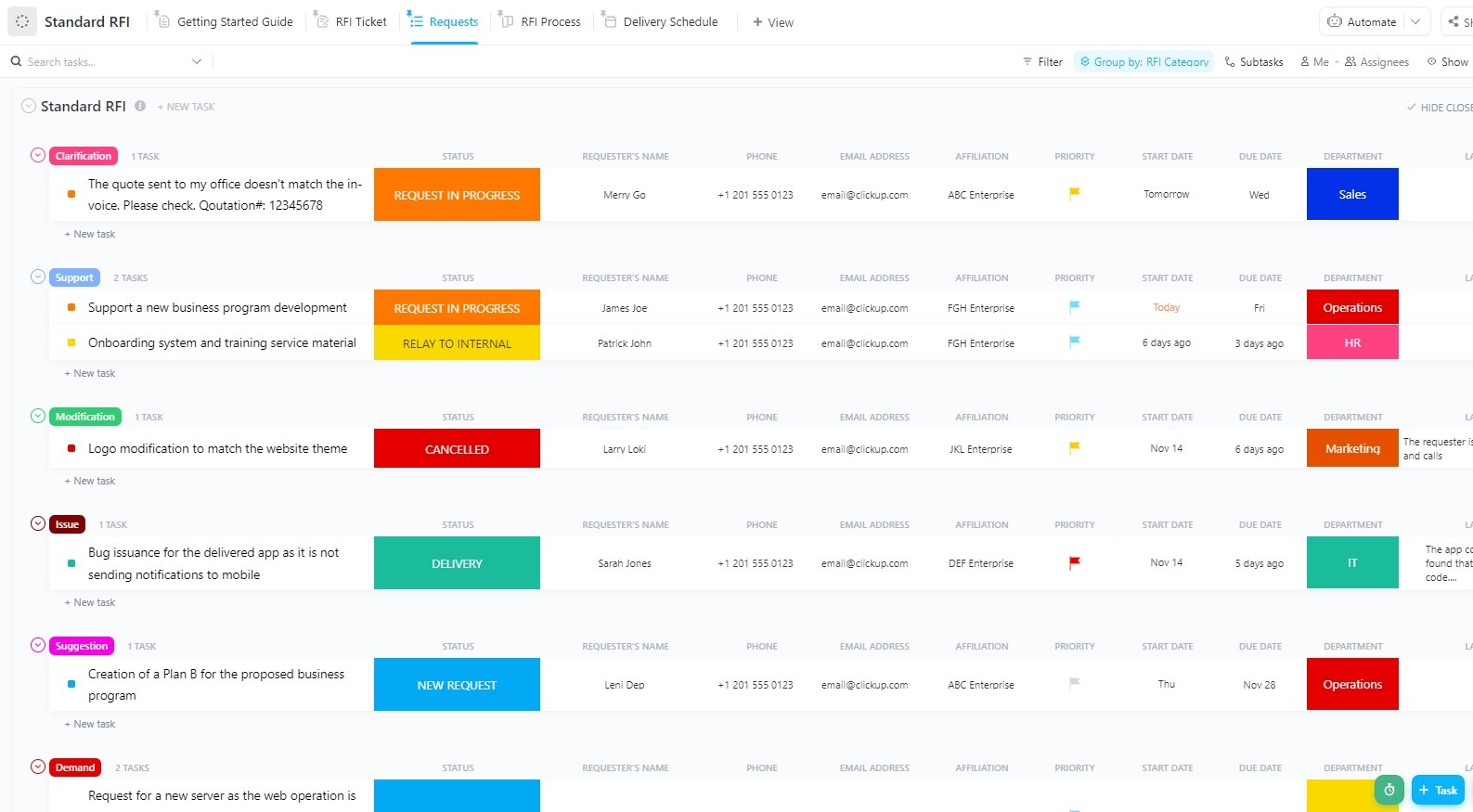
If you’re in the early stages of exploring a niche software, an RFI template organizes your data by capturing vendor responses in a single document. ClickUp provides a standard RFI template to track and compare vendor details, including business background, relevant experience, and available services or products.
When to use RFI:
- You’re exploring new software categories
You’re unfamiliar with the tools available and need to understand the landscape before narrowing down options. - You’re evaluating emerging technologies in a certain niche
Your team wants to stay ahead of industry trends but needs input from vendors to assess feasibility and relevance. - You’re defining project requirements
You’re still shaping the project scope and need guidance on what’s commonly offered. - You’re identifying potential vendors
You want to build a shortlist of qualified providers before requesting detailed proposals. - You’re comparing approaches to solve a problem
You’re open to different methods or models and need expert input to refine your strategy.
What is a request for proposal (RFP)?
A request for proposal (RFP) is used for inviting vendors to submit solutions in order to address a business need. In this stage, an RFP comes into play once a company has defined its goals and is ready to compare vendor offerings. Soliciting proposals allows you to select which one best meets your company’s requirements, whether that includes your target timeline or budget range.
You’ll commonly find these elements in a standard RFP:
- Project overview: Summarizes the context, goals, and purpose of the request.
- Scope of work: Describes what needs to be delivered and outlines the tasks involved.
- Project timeline: States important dates such as the submission deadline and projected start.
- Evaluation criteria: Explains how responses will be assessed and what matters most.
- Budget expectations: Provides an estimated budget range or request for pricing details.
- Submission instructions: Lists formatting requirements, contact details, and how to submit the proposal.
Tip: When drafting an RFP, I typically outline the pain points of my project including the requirements for the work being requested. I recommend avoiding rigid instructions and instead allowing space for vendors to suggest their own methods that best meet those goals.

A work management platform such as monday.com provides an RFP template with sections that help you specify the details you expect in a vendor’s proposal. It simplifies how you communicate requirements and ensures consistency, no matter the scope of your project.
Read more top tips for writing a successful project proposal.
When to use RFP:
- You’ve defined your requirements
The project goals are clear and you need vendors to propose specific solutions. - You’re comparing vendor strategies
You want to evaluate how different providers would approach the same problem. - You’re narrowing down to one or two vendors
You need a structured way to assess who offers the best value and fit.
What is a request for quotation (RFQ)?
A request for quotation (RFQ) is a formal document sent to shortlisted vendors to obtain pricing for goods or services. Organizations use it when they already know which vendors can meet their requirements and need specific cost details to move forward. This helps streamline cost comparison and identify the vendor that offers the best value.
The following components are generally present in an RFI.
- Itemized list of products or services
Details the exact materials, components, or services required for the project. - Technical specifications
Defines precise measurements, quality standards, and performance expectations. - Quantity and unit details
States the amount needed and the units of measure to help vendors quote accurately. - Delivery schedule
Specifies when and how the goods or services should be delivered. - Payment terms
Outlines acceptable payment conditions such as discounts or installment schedules.
Tip: When I prepare an RFQ, I ensure it lists all technical and functional requirements so vendors can provide accurate quotes. I opt for a template like Smartsheet’s that outlines quantities, delivery timelines, and service standards while also leaving room for negotiations.
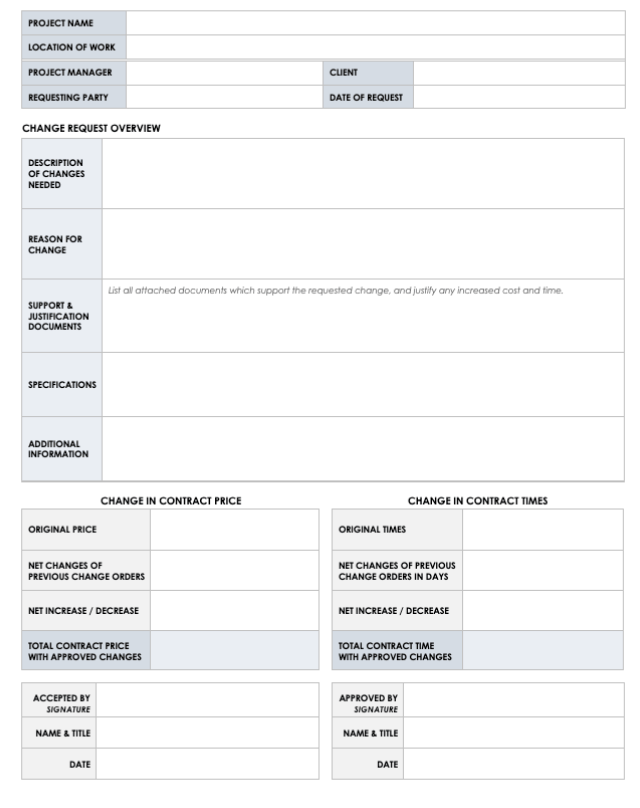
If you need a ready-to-use RFQ, Smartsheet provides templates designed for requesting pricing, goods, or services from vendors. As a project management platform, it also lets you store all vendor quotes in one workspace and use built-in formulas to calculate which option best fits your budget.
When to use RFQ:
- You’ve finalized your project requirements
The project scope is clear and you only need pricing to move forward. - You’re ready to compare supplier costs
Vendors are asked to provide detailed quotes for identical specifications. - You need budget validation before approval
The finance or procurement team requires accurate cost estimates for planning. - You’re running a competitive bidding process
You want suppliers to compete for the contract based on cost and delivery terms. - You’re purchasing standardized goods or services
The organization needs items or services that can be easily compared by price and availability.
What are the tips for writing RFIs, RFPs, and RFQs?
Beyond understanding how RFIs, RFPs, and RFQs differ, it’s equally important to know how to structure them to ensure relevant responses from vendors. Before drafting your request, keep these practical tips in mind to attract relevant, high-quality submissions.
- Be clear about your intent – Define the purpose of your request so vendors understand whether you’re gathering information, evaluating proposals, or collecting pricing. You can include background details about your company and project goals so vendors can tailor their answers.
- Avoid asking for too much too early – Don’t include detailed cost breakdowns in an RFI or creative solution requests in an RFQ. Mixing objectives can frustrate vendors and weaken the quality of responses.
- Set realistic deadlines – Give vendors enough time to prepare thoughtful, accurate responses. Short deadlines often result in rushed or incomplete submissions.
- Review before sending – Check that your document uses clear terminologies, includes all required sections, and aligns with your procurement stage.
Read more top tips for writing a successful project proposal.
Which should you use—RFI, RFP, or RFQ?
Each request serves a unique role in the sourcing process, and understanding when to use each one helps you save time and make informed decisions. In most cases, the sequence follows an RFI → RFP → RFQ flow, though there are exceptions, such as when adding components to existing systems, where you can move directly to an RFQ.
Use these guidelines when deciding which type of request to use.
- Use an RFI when you’re still exploring the market: This is the best time to collect information about what solutions exist in the market and which vendors are capable of meeting your needs.
- Use an RFP when you’re comparing solutions: It work well when you already know your goals and need vendors to propose methods or plans for achieving them.
- Use an RFQ when you’re ready to collect final pricing: Once your requirements are fixed, and solution proposed, you need cost estimates to make a purchase decision.
Tip: Keeping your RFP and your RFQ closely aligned is crucial to avoid costly scope creep on the project. Your RFQ is your best (and last) chance for tightly defining what resources will be used to deliver on what you’ve discussed in the RFP. Your RFQ should also include clearly worded provisions for how beyond-scope work will be documented, estimated, and approved.
FAQs
Does RFI or RFP come first?
An RFI typically comes before an RFP, since it helps organizations gather general information before defining requirements. However, an RFP can be issued without an RFI when the organization already understands its needs. This flexibility allows teams to choose the sequence that fits their sourcing process.
How does RFI differ from RFQ?
An RFI gathers broad information about vendor capabilities and market options, while an RFQ requests pricing for specific goods or services. The RFI focuses on discovery and research, whereas the RFQ is used when requirements are fixed and cost comparison is the main goal.
Are RFP and RFQ the same?
No, they serve different purposes. An RFP asks vendors to propose solutions for a defined problem, including methods and pricing. An RFQ, on the other hand, requests only price estimates for specified items or services. Both belong to the RFI RFP RFQ process but occur at different stages.