


















Project management courses make a good investment for your professional growth, especially if you want to build confidence and credibility as a project leader. The best project management courses cover everything from foundational concepts to agile methodologies and industry-specific practices. These programs can open doors to new career opportunities, but the right choice depends on your experience level, learning goals, and how much time and effort you’re ready to commit. Explore your best options below.
- Expert contributors
- Best project management courses: An overview
- 1. Certified ScrumMaster® (CSM)
- 2. Agile Meets Design Thinking
- 3. PRINCE2 7 Foundation and Practitioner
- 4. Project Management Professional (PMP)® PMI Study Hall® Plus
- 5. Certified Associate in Project Management (CAPM) Exam Prep Course
- 6. PM PrepCast™ Course
- 7. Agile Project Management by Google
- 8. Harvard ManageMentor: Project Management
- What is project management certification and why does it matter?
- Best project management certification for every career level and industry
- Free vs. paid certifications: What’s the difference?
- Choosing the right certification for your career goals
- FAQs
Expert contributors
The project management courses in this guide were handpicked by certified professionals whose expertise spans client-facing strategy and project delivery, bringing both depth and practicality to every recommendation.

Rahim Thompson, CAPM, PMP
Senior Program Manager at Illinois Holocaust Museum & Education Center
Find Rahim on LinkedIn

Manu Sood
Product Manager at ProofHub
Find Manu on LinkedIn

Jamilyn Trainor
Senior Project Manager and Owner at Müller Expo Services International
Find Jamilyn on LinkedIn
Best project management courses: An overview
Here’s a quick comparison of the best project management courses to help you choose based on your goals, budget, and availability.
| Best for | Cost | Duration | Learn more | |
|---|---|---|---|---|
| Certified ScrumMaster® (CSM) | Project leads overseeing agile or Scrum-led teams | Starts at $250 | 16 hours | Visit Scrum Alliance |
| Agile Meets Design Thinking | Beginners familiar with product development | Free | 9 hours | Visit Coursera |
| PRINCE2 7 Foundation and Practitioner | UK-based professionals involved in process-heavy projects | Starts at $2,486 | 32 hours | Visit PRINCE2 |
| Project Management Professional (PMP)® PMI Study Hall® Plus | Preparing for the PMP exam | $79 | 3-month access | Visit PMI |
| Certified Associate in Project Management (CAPM) Exam Prep Course | Aspiring project managers preparing for the CAPM exam | Starts at $350 | 23 hours | Visit Coursera |
| PM PrepCast™ Course | Aspiring PMs prepping for the PMP exam | Starts at $279 | 35 hours | Visit PM Prepcast |
| Agile Project Management by Google | Exploring a career in product development | Free | 20 hours | Visit Coursera |
| Harvard ManageMentor: Project Management | Entry-level PM professionals | Starts at $10 | 2 hours | Visit Harvard Business Impact |
*Note: Information in this guide is current as of May 2026.
1. Certified ScrumMaster® (CSM)
| Recommended by | Manu Sood |
|---|---|
| Cost | $250 and $2,495 |
| Course length | 16 hours of instructor-led classes, delivered over two consecutive full days or four half-day sessions |
| Course provider | Trainers authorized by Scrum Alliance |
| Visit Scrum Alliance | |
For those working in agile environments, Sood points to the Certified ScrumMaster (CSM) from Scrum Alliance as a certification worth pursuing. “The Certified ScrumMaster from Scrum Alliance is also valuable for those working in agile environments or with scrum teams,” he said.
The course provides a hands-on introduction to Scrum, covering everything from roles and events to user stories and sprint planning. It’s designed to help project professionals apply real-world Scrum practices directly, whether supporting an agile team or stepping into a more active leadership role.
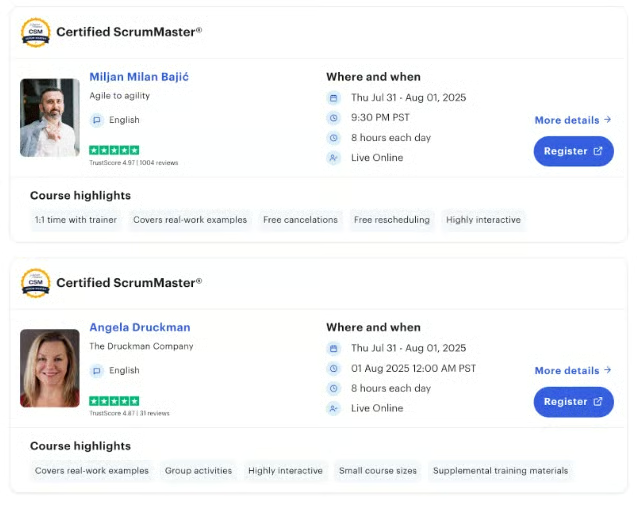
The workshops are highly interactive, mixing short lectures with group exercises, simulations, and team activities that reflect real-world project scenarios. By the end, participants leave with the confidence to guide teams through agile delivery and support a broader organizational shift toward an agile mindset.
Courses are listed directly on the Scrum Alliance website under Certified ScrumMaster, where a global directory of trainers can be filtered by language, schedule, location, trainer preference, or available discounts. Pricing varies by trainer, and the training fee covers the certification exam as well.
2. Agile Meets Design Thinking
| Recommended by | Manu Sood |
|---|---|
| Cost | Free |
| Course length | 9 hours to complete (self-paced) |
| Course provider | University of Virginia |
| Visit Coursera | |
For professionals working across product and software teams, Sood points to Agile Meets Design Thinking as a niche course worth taking. “The niche course that helped me specialize was Agile Meets Design Thinking,” he said. “It gave me practical tools to merge agile processes with user-centred design. I often work on software and product teams that need to balance rapid iteration with good user experience, so the course was very relevant to my day-to-day projects.”
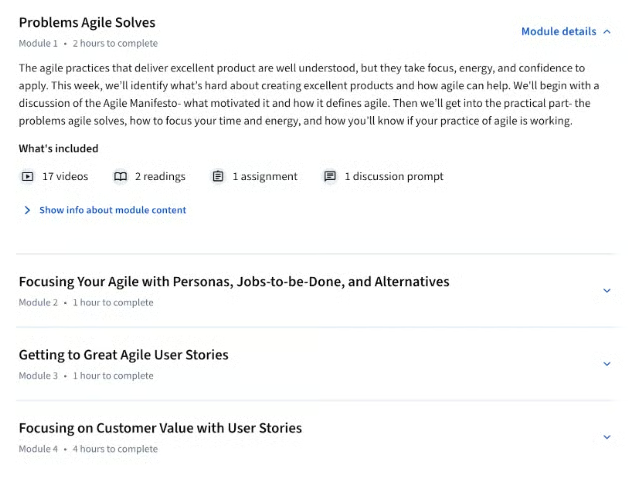
The program teaches how to identify real user needs through personas, problem scenarios, and testable narratives. By the end of it, you’ll learn how to turn those insights into agile user stories and use them as a foundation for collaboration, prototyping, and continuous feedback within your team.
Two learning tracks are available: Digital Product Management and Agile Development. The right choice depends on which area of agile practice aligns with your role and where you want to take your career.
3. PRINCE2 7 Foundation and Practitioner
| Recommended by | Manu Sood |
|---|---|
| Cost | Starts at $2,486 |
| Course length | 32 hours |
| Course provider | PRINCE2 |
| Visit PRINCE2 | |
PRINCE2, which stands for PRojects IN Controlled Environments, is a process-driven methodology designed to help teams deliver projects on time, within budget, and with risks properly managed. Sood considers it a strong fit for professionals working in the UK, where it tends to be the preferred standard over other project management approaches.
“When choosing specialized certifications or training, the important thing is to look at the kinds of companies and clients you plan to work with,” Sood noted. “Some industries, like finance, healthcare, or government, may require or strongly favour certain credentials that align with their processes or regulations. Similarly, different regions have their own recognized standards, like PRINCE2 for the UK.”
The course is offered at two qualification levels: Foundation and Practitioner. Foundation introduces the core principles of PRINCE2, while Practitioner focuses on applying those principles to project scenarios.
Four delivery formats are available to fit different schedules and learning preferences. Self-paced e-learning comes with 12 months of access, and virtual live sessions are available for those who prefer real-time instruction. A blended option lets you complete Foundation through self-paced e-learning before moving into a virtual classroom for Practitioner. In-person classes are also available, with both instructor-led formats for five days.
4. Project Management Professional (PMP)® PMI Study Hall® Plus
| Recommended by | Rahim Thompson, CAPM, PMP |
|---|---|
| Cost | $79 (billed quarterly thereafter) |
| Course length | Three months of access |
| Course provider | PMI |
| Visit PMI | |
PMI Study Hall Plus is a digital learning tool built to support preparation for the Project Management Professional (PMP) certification, a credential designed for project managers with three to five years of experience who want to validate their skills.
Thompson speaks to its value from personal experience. “The most valuable resource I have used is PMI Study Hall Plus,” he says. “As I prepared for the PMP exam, this digital learning tool provided feedback after each question that helped me understand the mindset PMI looks for in PMP-certified professionals. It didn’t just help me absorb content. It gave me the confidence and momentum to reschedule and take the PMP exam sooner than planned.”
A subscription includes three months of access with 175 practice questions, premium webinars, a mini practice exam, and guided lessons. Flashcards, videos, and gamified activities are also included to keep motivation steady throughout the process. Upon logging in, you’ll be prompted to enter your exam date, which generates a personalized study plan and sets daily goals.
5. Certified Associate in Project Management (CAPM) Exam Prep Course
| Recommended by | Manu Sood |
|---|---|
| Cost | $49/month (subscription-based) |
| Course length | 4 weeks at 10 hours a week (self-paced) |
| Course provider | Packt – Course Instructors |
| Visit Coursera | |
This exam prep course is worth considering for professionals pursuing the CAPM certification who want to build credibility early in their project management career. Sood recommends it for those still finding their footing. “For those looking at foundational aspects, I would also recommend the CAPM from PMI, which is ideal for those starting out as it offers foundational knowledge and is well-respected by employers,” he said.
The three-part course series is based on the PMI framework. It opens with the fundamentals of project management, then moves into key methodologies including predictive, adaptive, and hybrid approaches to show how each applies across different project environments. The final section covers business analysis techniques and walks you through the CAPM exam structure
6. PM PrepCast™ Course
| Recommended by | Jamilyn Trainor |
|---|---|
| Cost | Ranges from $279 to $389 |
| Course length | 35 hours of self-paced video lessons |
| Course provider | PM Prepcast |
| Visit PM Prepcast | |
Trainor used Cornelius Fichtner’s PMP Exam Simulators to prepare for her PMP certification and found them far more effective than traditional study materials. “I prepared for my PMP with Cornelius Fichtner’s PMP Exam Simulators, which were a million times more useful than the textbooks,” she said. “This was authentic exam logic, not just content.”
Offered by PrepCast, the simulator is part of a broader training package that includes 35 hours of video instruction and study materials covering agile and hybrid methodologies. The PM PrepCast course complements PMI’s PMBOK Guide with straightforward explanations and real-world examples that make complex concepts easier to grasp. It also comes with a study checklist, newsletter subscription, and access to a discussion forum where PMP candidates can connect and ask questions throughout their preparation.
7. Agile Project Management by Google
| Recommended by | Manu Sood |
|---|---|
| Cost | Free |
| Course length | 20 hours |
| Course provider | Google Career Certificates |
| Visit Coursera | |
For professionals planning to pursue the Agile CSM certification, Sood recommends starting with Google’s Agile Project Management course to build familiarity with the core concepts. “The Agile CSM certification was definitely worth the investment,” he said. “It’s directly relevant to my work in software development and has good scope for career growth.”
The course centers on agile methodologies widely used in tech and product development, while covering concepts relevant to CSM preparation. It’s divided into four modules that introduce the core principles of agile and the Scrum framework. From there, you’ll explore Scrum’s pillars and values, compare key Scrum Team roles, and learn how to coach agile teams through common challenges.
8. Harvard ManageMentor: Project Management
| Recommended by | Jamilyn Trainor |
|---|---|
| Cost | Degree-granting course: $10 per student Non-degree-granting course: $25 per student |
| Course length | 2 hours of self-paced lessons |
| Course provider | Harvard Business Publishing |
| Visit Harvard Business Impact | |
For Trainor, Harvard ManageMentor’s Project Management module gave her the confidence to apply project management principles in high-pressure situations.
“I wasn’t expecting it, but one of the most useful learning resources was Harvard ManageMentor’s Project Management module,” she said. “The case studies grounded my learning and helped me become a better decision maker in often chaotic cross-functional projects.”
The two-hour course covers the essential skills and techniques needed for effective project management. You’ll learn how to define project scope, identify stakeholders and key objectives, and build a realistic schedule and budget. It also walks through monitoring project costs, timelines, scope, and quality, and how to keep stakeholders informed at every stage. Insights from business leaders and coaches are included throughout, drawing on real-world experience and proven practice.
What is project management certification and why does it matter?
A project management certification is a professional credential proving you’ve gained the knowledge, skills, and training to manage projects effectively. It’s awarded by a recognized organization after you complete a course and pass an exam.
The type of certification you earn reflects your ability to understand project processes, manage risks, and lead teams across a variety of project environments. Some certifications also require relevant work experience and an application review process, adding an extra layer of credibility by validating your expertise in the field.
Earning a project management certification matters because it validates your expertise and enhances your credibility to future employers. Beyond strengthening your resume, it also supports long-term career growth through promotions, higher pay, continuous learning, and better project outcomes.
Best project management certification for every career level and industry
Now that you’re familiar with the best project management courses, it’s time to explore the certifications that align with your experience level and industry goals. From entry-level roles to executive leadership, each certification offers a clear path to grow your skills and advance professionally.
Entry-level
1. Certified Associate in Project Management (CAPM)
This certification is a strong starting point for early-career professionals who want to validate their knowledge and skills in project management. It requires 23 hours of project management education before taking the exam, which you can fulfill through the recommended prep course mentioned above. As a stepping stone toward the PMP certification, it provides the knowledge to meet the educational requirement while equipping you with the core skills to advance your career.
2. PRINCE2 Foundation
The PRINCE2 Foundation is the standard project management approach in the UK, which uses a framework to manage and control projects. It introduces key principles to help you operate in project teams driven by PRINCE2 methodology. If you work in a supporting project role, obtaining the PRINCE2 Foundation certification is recommended.
Mid-level certification
1. Project Management Professional (PMP)
This globally recognized certification proves you have the leadership skills and expertise to manage projects across any industry using predictive, agile, or hybrid approaches. It requires three to five years of experience and validates your ability to manage people, processes, and business goals effectively.
There is also an education requirement, both through a formal project management course and an academic background, to ensure you have the necessary theoretical knowledge. Additionally, you must apply and be approved before taking the timed exam, as part of a formal review process that verifies your eligibility.
2. Certified ScrumMaster (CSM)
The CSM certification demonstrates your agile leadership skills and commitment to applying Scrum principles effectively. To earn it, you must complete a two-day course with a Certified Scrum Trainer and pass a 50-question exam with a score of at least 74 percent.
3. Agile Certified Practitioner (PMI-ACP)
This certification validates your expertise in agile practices and your ability to lead teams using frameworks like Scrum, Lean, and Kanban. You can confidently apply agile principles with the right mindset, tools, and skills in dynamic team environments. For the certification, you need 24 months of agile experience within the last five years and 28 hours of formal training in agile practices, although holding a current PMP can satisfy part of the experience requirement.
Like the PMP, there is also an application process to verify your eligibility, followed by a timed exam that assesses your knowledge and ability to apply agile principles in real-world scenarios.
Senior-level certification
1. Program Management Professional (PgMP)®
The PgMP certification is for senior professionals who manage multiple, related projects and drive better project results. It confirms your ability to handle complex program structures, balance competing priorities, and align initiatives with organizational goals.
If you have a bachelor’s degree, you’ll need either 48 months of both project and program management experience, or 36 months of each if your degree is from a Global Accreditation Center (GAC)–accredited program. Earning this credential also supports your ongoing professional development, which plays a key role in staying relevant and effective as a project management leader.
Candidates must also complete an application process, with most applications audited by PMI, and pass a rigorous timed exam.
2. Portfolio Management Professional (PfMP)®
The PfMP certification is built for senior-level professionals and executives who are responsible for prioritizing initiatives, managing risk, and ensuring portfolio value across the organization. Bachelor’s degree holders require eight years of business experience, along with either four years of portfolio management experience or three years if your degree is from a GAC-accredited program.
This credential validates your ability to align portfolios with organizational strategy and deliver sustainable results. Like the PgMP, the candidates must go through a formal application process, with most submissions audited by PMI, and complete a timed exam.
By industry
1. CompTIA Project+
This entry-level certification exam is for IT professionals managing small to medium-sized projects and need to validate their project planning and coordination skills. It’s recommended that you have 6 to 12 months of hands-on project experience in an IT setting before taking the exam.
2. Cognitive Project Management in AI (CPMAI)™
This is an advanced certification that expands on the CPMAI methodology by integrating the Trustworthy AI Framework, with a focus on ethical, transparent, and accountable AI project practices. It validates your ability to lead AI initiatives while observing responsible and fair implementation standards. To enroll, you must first complete the CPMAI™ v7 training and certification course.
3. PMI Construction Professional (PMI-CP)™
The PMI-CP certification is for project managers in the construction industry who want to strengthen their ability to lead teams, manage contracts, and deliver successful projects. It prepares you to handle real-world challenges while staying current with evolving practices in the built environment. Takers must complete four training modules and have at least three years of hands-on experience with construction within the past 10 years.
Free vs. paid certifications: What’s the difference?
When deciding between free and paid certifications, it’s important to look beyond the cost. Free options can be a budget-friendly way to build foundational knowledge, particularly for those new to the field or still exploring different approaches.
Paid certifications, however, offer comprehensive training materials, more recognized credentials, and closer alignment with industry standards like PMI or PRINCE2. For professionals targeting senior or leadership roles, that added credibility often carries more weight with employers.
Choosing the right certification for your career goals
The right certification depends on where you are in your career and what you’re working toward. Entry-level options like CAPM or PRINCE2 Foundation suit those earlier in their journey, while more advanced credentials like PMP or PgMP make more sense once you’ve built experience and are ready to take on larger initiatives.
It’s also worth factoring in renewal requirements. Some certifications require a set number of Professional Development Units (PDUs) earned within specific timeframes to stay active. Before committing, weigh your current skills, career goals, the industry you want to grow in, and your capacity to keep up with any long-term requirements.
FAQs
Is PMP still worth it?
Yes, the PMP remains one of the highly respected certifications in project management, especially if you’re aiming for leadership roles or managing complex projects across industries.
Which is better, PMP or APM?
PMP is more globally recognized and suited for experienced project managers, while APM is ideal if you’re early in your career or working in UK-based organizations. Either way, the best project management course online is the one that matches your current experience level, learning goals, and the type of projects you plan to lead.
What is the best way to learn project management?
The best way to learn project management is a combination of training and hands-on experience. You can start with a foundational course or certification, then apply what you learn in your team projects.