SHARE
Facebook X Pinterest WhatsApp

Project Coordinator vs Manager: Roles, Pay & Path Differences

Compare coordinator vs manager on duties, authority, pay, tools, and career path—plus when to hire each and how to move from coordinator to PM.

Written By
thumbnail
Marianne Sison
Marianne Sison
Dec 9, 2025
project-management.com content and product recommendations are editorially independent. We may make money when you click on links to our partners. Learn More
Key takeaways
  • Coordinators can advance by leading small projects and earning recognized certifications such as the CAPM.
  • The project coordinator handles project tracking and team communication, while the project manager directs planning and delivery to ensure results align with business goals.
  • Coordinators provide admin support and rely on the manager for guidance, while managers make decisions that influence scope and outcomes.

A project coordinator oversees the administrative aspects of a project to keep workflow, budget, and schedule aligned with objectives, while a project manager takes full responsibility for the project lifecycle, including planning, risk control, and decision-making. In the context of project coordinator vs project management, coordination operates within its larger framework, concentrating on project organization and consistent communication. 

Whether you’re exploring a career in project management or comparing these roles, this guide explains how a project coordinator vs a project manager differ.

How the project coordinator and project manager roles differ

AreaProject coordinatorProject manager
FocusKeeps daily operations organized and supports project execution.Oversees project delivery and ensures alignment with business goals.
Core tasksTracks schedules, updates documentation, takes meeting notes for the project manager, and communicates progress.Plans projects, allocates budgets, leads teams, and resolves issues.
Typical skillsCommunication, time management, conflict resolution.Leadership, strategic planning, risk management, stakeholder communication.
CertificationsCertified Associate in Project Management (CAPM) and Projects in Controlled Environments (PRINCE2) for foundational project knowledge.Project Management Professional (PMP) for advanced project leadership.
Salary (US)$60,000 to $95,000 per year$80,000 to $138,000 per year
Career pathTypically an entry-level project role that leads to project or program management.Advanced role with paths to senior PM, program manager, or portfolio lead.
When to hireIdeal for growing teams that need added support with coordination and reporting when one project manager cannot cover all tasks and hiring multiple PMs is not practical.Best for organizations managing complex projects that require leadership and accountability.

Let’s break down each role in detail to show how the project manager and coordinator roles diverge in focus and the types of impact they bring to a project’s success.

What are the roles of project coordinators vs project managers?

Understanding the differences between the roles of a project coordinator and manager is key if you’re deciding how to enter or advance your career in project management. Coordinators focus on administrative tasks and ensuring everything runs smoothly, while the manager takes ownership of planning and leadership. 

Let’s take a closer look at how their responsibilities and daily roles diverge.

Project coordinator responsibilities

Project coordinators support the administrative and operational side of a project. Their job is to keep everything documented and to take charge of day-to-day coordination to help the manager drive the project toward its goals.

  • Schedule meetings and monitor resource availability
  • Track project progress and maintain updated documentation
  • Communicate updates between team members and stakeholders
  • Escalate issues to the project manager when bottlenecks occur
  • Coordinate task assignments across departments
  • Monitor deliverables to meet deadlines and standards
  • Prepare reports and summaries for internal distribution
  • Record meeting notes, key decisions, and due dates for the project manager
  • Manage resources and shared tools like calendars and project platforms

Project manager responsibilities

Project managers assume a broader leadership role by taking the project from initiation to delivery. They are responsible for making critical decisions and developing high-level strategies. 

  • Plan project scope, deliverables, and timelines
  • Allocate budgets and control costs throughout the project lifecycle
  • Lead cross-functional teams and provide clear direction
  • Make strategic decisions to resolve risks and roadblocks
  • Set priorities and adjust plans based on changing needs
  • Communicate directly with executives and key stakeholders
  • Facilitate and lead project meetings and provide status updates
  • Ensure project goals align with business objectives
  • Close out projects with performance reviews and lessons learned

Looking to advance your project management career? Check out our guide on project manager interview questions to prepare for common scenarios and learn how to showcase your leadership and problem-solving skills effectively.

What skills are required for project coordinators and project managers?

Project professionals can advance their careers and increase earning potential by developing the skills employers value most. According to the Project Management Institute (PMI), culture and employee engagement rank among the top priorities in North America. In addition to those, here are the key skills that will help project coordinators and managers succeed in their roles.

Project coordinator skills

Project coordinators rely heavily on effective communication and organization to support the day-to-day workflow. Strong attention to detail, time management, and teamwork are essential. Since coordinators often serve as a bridge between departments, clear documentation and interpersonal skills go a long way.

  • Written Communication: Coordinators spend a lot of time documenting updates, sending status reports, and clarifying tasks across teams. Clear written communication helps prevent misunderstandings and ensures everyone stays aligned.
  • Multitasking: Coordinators often juggle schedules, task updates, and team check-ins simultaneously. Being able to switch between responsibilities is key to maintaining momentum.
  • Teamwork: This role depends on building strong working relationships across departments. Coordinators act as the link between team members, so trust and cooperation are vital.
  • Adaptability: Project details and timelines can shift unexpectedly. Coordinators need to adjust quickly without losing track of priorities or progress.

Project manager skills

Project managers lead initiatives from concept to completion, so they need both leadership skills and technical expertise. Strategic thinking and risk management are integral to the role, as well as the fluency in the tools that drive visibility and control over the project lifecycle.

  • Leadership: Project managers are responsible for setting direction and motivating the team to stay focused on outcomes. Effective leadership requires decisiveness, accountability, and the ability to rally others behind a shared goal.
  • Critical thinking: Project challenges rarely come with clear answers. Managers must analyze trade-offs and choose the best course of action based on limited information.
  • Conflict resolution: Project teams may face disagreements over priorities or responsibilities. It’s up to the manager to address tension early and guide the team back toward collaboration.
  • Stakeholder alignment: Project managers must keep executives and clients informed while balancing their expectations with what the team can realistically deliver. Strong stakeholder alignment improves support and reduces the risk of last-minute changes.

Top tools for project coordinators and managers

A survey by monday.com revealed that 37% of senior leaders believe software updates have made their jobs much easier, and 25% of managers share the same view. This highlights how project management tools simplify complex workflows for project roles by centralizing communication and reporting.

For a smoother transition between higher project management roles, here are the top tools that support efficiency and collaboration.

1. monday.com – Best for visual workflows

Screenshot of monday.com marketing plan board showing tasks grouped by quarter, each with assigned team members, statuses, timelines, priorities, goals, budgets, and source channels.
Use monday.com to organize project timelines and team responsibilities in one customizable dashboard for better visibility and faster execution. (Source: monday.com)

For professionals aiming to work more efficiently, monday.com offers a visual work management platform that helps teams organize tasks, automate processes, and get started quickly with customizable templates. Its intuitive design makes it easy for both coordinators and managers to keep projects on track.

2. ClickUp – Best for task management

Screenshot of ClickUp’s Gantt chart showing project tasks with color-coded timelines, team member assignments, and dependencies across multiple projects.
Use ClickUp’s Gantt chart view to visualize project timelines, track task dependencies, and coordinate team activities more efficiently. (Source: ClickUp)

Task management software helps project coordinators strengthen their organizational and communication skills by keeping work visible and structured. ClickUp makes this easier by allowing you to visualize project progress through views such as tables and dynamic Gantt charts, enabling seamless coordination through clear task assignments and real-time progress tracking.

3. Smartsheet – Best for portfolio management

Screenshot of Smartsheet portfolio dashboard showing total projects, budget progress, strategic objectives, and department performance metrics for portfolio management.
Smartsheet’s Control Center dashboard gives executives real-time visibility into project portfolios to help them track budgets, resources, and risks from a single workspace. (Source: Smartsheet)

Project managers benefit from portfolio-level tools that provide visibility and control across multiple initiatives. Smartsheet supports this through its Control Center dashboard, providing executives with a real-time view of performance across the org’s entire portfolio of projects and deliverables. From a single console, you can track risk, monitor resources, and manage budgets while keeping large-scale projects aligned with organizational goals.

How much do project coordinators and project managers earn?

Salary often reflects the scope and responsibility of each role, along with local market conditions and the size of the company doing the hiring. Understanding current pay ranges for project coordinators and project managers helps you gauge career growth and identify which path aligns with your experience and goals.

Project coordinator salary overview

CategoryDetails
Total pay range$60,000 to $95,000 per year
Median total pay$75,000 per year
Base pay range$50,000 to $76,000 per year
Top-paying industriesAerospace & defenseGovernment & public administrationEnergy, mining & utilitiesFinancial servicesConstruction & maintenance

Data source: Glassdoor – April 10, 2025

Coordinator salaries vary widely depending on industry and region. Those working in sectors like aerospace, government, or power tend to earn more than their counterparts in education or retail. Geographic location also has a strong impact, as those working in high‑cost metro areas (e.g., San Francisco, New York) typically offer premium pay.

Project manager salary overview

CategoryDetails
Total pay range$80,000 to $138,000 per year
Median total pay$105,000 per year
Base pay range$65,000 to $110,000 per year
Top-paying industriesEnergy, mining & utilitiesAerospace & defenseFinancial servicesLegal Construction & maintenance

Data source: Glassdoor – April 10, 2025

Project managers in the U.S. earn significantly more than coordinators, with a median annual salary of $105,000. The total compensation package ranges from $80,000 to $138,000, and many roles offer an additional $15,000 to $29,000 in bonuses or incentives. 

The industry has a major impact on earnings, as workers in energy, aerospace, and financial services earn top-tier salaries. Companies like Chevron, ConocoPhillips, and Lockheed Martin consistently rank among the highest-paying employers for project managers.

Did you know? Professionals with a PMP® certification earn higher median salaries than those without this credential, averaging 33% more across 21 countries.

Career roadmap: How to move from project coordinator to project manager

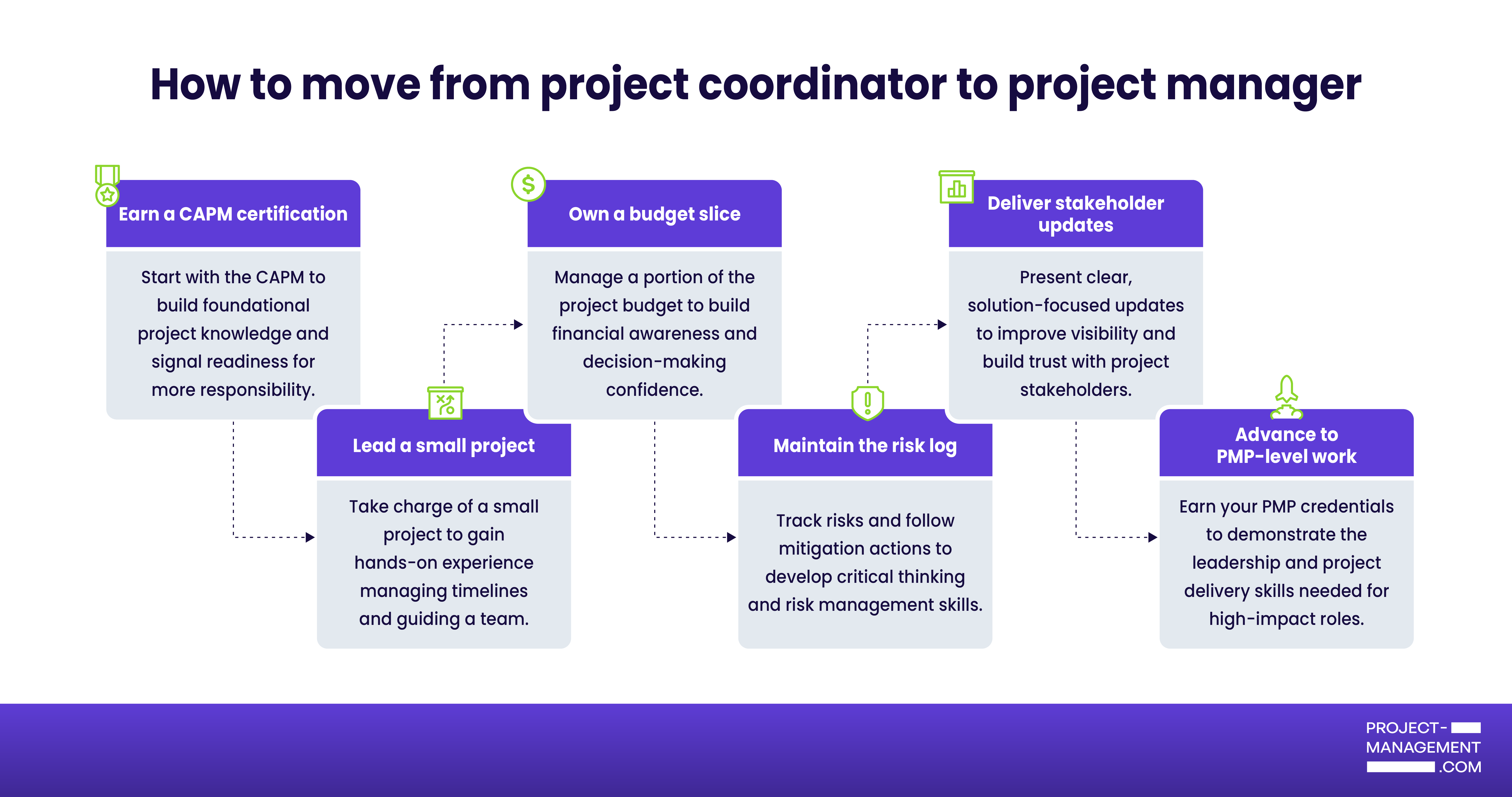
Many project coordinators grow into project management roles by gradually increasing their ownership and decision-making authority. While experience helps, career advancement depends on your ability to lead and manage risk. If you’re aiming to step into a project manager role, here are ways to build the right credentials and experience.

How to move from project coordinator to project manager

1. Earn a CAPM certification

Start by earning the Certified Associate in Project Management (CAPM) from PMI to formalize your understanding of project management principles. This entry-level certification confirms your understanding of PMI’s processes and terminology, which strengthens your credibility as a coordinator and prepares you for greater leadership responsibilities.

Before taking the exam, you need either a high school diploma or equivalent and 23 hours of  project management education, such as courses on project scheduling, cost management, or stakeholder communication. These programs are offered by PMI-authorized training partners, universities, or online learning platforms like Coursera and Udemy. Once you’ve earned your CAPM, apply what you learn to small projects before advancing to larger initiatives.

2. Lead a small project

Managing small projects is a practical way to build leadership skills without the pressure of full-scale responsibility. You’ll have a chance to create timelines, coordinate resources, and guide a team toward a defined outcome. After completing a few successful small projects, you’ll be ready to take on more ownership within a project’s scope.

3. Own a budget slice

Taking charge of a portion of the project budget strengthens your financial judgment and accountability. You’ll get exposure to real cost tracking while learning how your decisions affect the overall spending. As you consistently meet financial goals, you can progress to managing full project budgets or cost centers.

4. Develop leadership and communication skills

Collaborating with different departments helps you build leadership, negotiation, and communication skills. Seek opportunities to speak in meetings and lead cross-functional discussions. Handling updates and reports also positions you as a trusted point of contact for project information.

5. Maintain the risk log

Once you’ve mastered budget and communication tasks, you can now begin managing risk documentation. Tracking potential issues and mitigation plans helps you understand how uncertainty affects timelines and performance. This habit strengthens your analytical thinking and prepares you for complex projects that demand proactive risk governance.

6. Earn the PMP certification

After gaining real-world experience and mastering foundational skills, you can move toward the Project Management Professional (PMP) certification. PMI requires a four-year degree, 36 months of project management experience, and 35 hours of formal project management education or CAPM certification to qualify. 

Once you meet these requirements, you must apply for the PMP exam and receive approval before taking and passing the test, which evaluates your ability to lead projects effectively across different industries and regions. Achieving this credential signals that you’re ready to manage complex projects and accept senior-level roles.

Where coordination fits in agile & modern teams

In modern teams, coordination plays an important role in both Agile (the formal framework) and agile (the adaptable mindset). In Agile environments, project managers and coordinators adjust their approach to support iterative delivery and team-driven planning. Authority is distributed, so project managers act as facilitators who guide delivery, while coordinators support them by managing documentation and keeping work flowing across the team.

The table below shows how traditional project coordination and management align with agile roles and responsibilities.

Traditional functionAgile/Scrum equivalentHandled byHow the role contributes
Scheduling and task trackingScrum MasterProject Coordinator (supports Scrum Master)Organizes schedules, prepares sprint planning materials, and documents stand-up notes while the Scrum Master facilitates the actual Agile ceremonies.
Documentation and reportingProduct owner or Scrum MasterProject coordinatorMaintains the sprint documentation, prepares reports, and updates user stories without assuming responsibility for backlog management or ceremony facilitation.
Stakeholder communicationProduct ownerProject managerMaintains communication between business stakeholders and development teams to align goals and priorities.
Risk management and escalationScrum Master and Agile teamProject managerIdentifies risks, manages impediments, and coordinates solutions to keep delivery on schedule.
Resource coordinationProject manager (Hybrid Agile)Project managerBalances workloads and ensures resources are used effectively across teams or vendors.

In Agile or lean settings, a project manager’s authority is based on influence and facilitation instead of hierarchy. The PM connects strategy to execution, while the coordinator supports transparency by maintaining documentation and progress flow between teams. Together, they ensure adaptability without losing accountability.

FAQs

Yes, coordination supports project management by handling timelines and team communication. Coordinators manage the day-to-day structure so managers can focus on planning and execution.

Certifications are not required but are highly useful in terms of professional development. Earning the CAPM or PRINCE2 Foundation helps coordinators understand standard frameworks and prepares them for advanced credentials later in their careers.

Definitely, a coordinator can move forward into a management role by leading small projects and gaining budgeting experience. Building leadership skills and earning credentials such as the PMP makes that transition easier.

Project managers in the U.S. earn significantly more than coordinators, with a median salary of $105,000 per year, according to Glassdoor. Managers command higher pay due to their broader scope and leadership duties, while coordinators focus on organization, reporting, and day-to-day project support.

Coordinators often work with task trackers such as ClickUp or monday.com. Managers use platforms like Wrike or Smartsheet to monitor progress and allocate resources efficiently.

In Agile settings, coordinators handle team alignment while Scrum Masters or Product Owners guide delivery. The traditional project coordinator vs project management hierarchy shifts toward collaboration and shared ownership.

Recommended for you...

How to Become a Freelance Project Manager in 2025
Aldinal Rachman
Jun 23, 2025
Delivering Bad News to Your Executive Team
Benefits of OKR Transparency
Sasi Dharan
Jan 5, 2022
Identifying & Managing Toxic Workplace Behaviors
Anne M. Carroll
Nov 22, 2021
project-management.com Logo

project-management.com is dedicated to providing modern tools, latest news, and best practice references for every project professional and business organization. The discipline of project management has continued to receive growing interest and attention over the past decades. Especially today, the importance and relevance of the project manager for any kind of undertaking is unquestionable. However, the challenges of modern society, business relationships and latest technology are also testing their competency and ability to deliver successful projects. Since its launch in 2001, PMcom has been featuring pertinent articles, management software and productivity tool reviews, books, interviews, training sites and other e-learning resources to help people be more productive and successful in their chosen path.

Property of TechnologyAdvice. © 2025 TechnologyAdvice. All Rights Reserved

Advertiser Disclosure: Some of the products that appear on this site are from companies from which TechnologyAdvice receives compensation. This compensation may impact how and where products appear on this site including, for example, the order in which they appear. TechnologyAdvice does not include all companies or all types of products available in the marketplace.